


Best Heroes for 5-Stack Ranked and Party Queue (2026)

The best heroes for 5-stack ranked and party queue are not the same as the best solo queue heroes. When all five slots are coordinated, a completely different tier list opens up — heroes like Io, Magnus, and Enigma jump from “risky in pubs” to “automatic win condition.” This guide covers the strongest picks for each role in patch 7.41f, the combos that break the game open, and how to draft a lineup your enemies cannot respond to without voice comms of their own.
Data labeled as community aggregator data is sourced from Stratz and Dota 2 Pro Tracker (D2PT), patch 7.41f, as of October 2026. Internal winrate data is from Batru.gg. Before building your 5-stack hero pool, check the 5-stack ranked rules and MMR range restrictions — there are hard-coded party caps that affect who can queue together.
Quick Navigation
Why 5-Stack Changes the Tier List
Solo queue rewards self-sufficient heroes because you cannot rely on teammates to execute anything on cue. The moment you add voice communication and four other people you trust, the entire calculus flips. Heroes that solo pub players rate as “pub stompers” — Sniper, Drow Ranger, Luna — drop in relative value because they solve the wrong problem. The problem you are actually solving in a 5-stack is coordination ceiling: you can execute plays that opponents running solo queue simply cannot replicate without a mic.
Three categories of heroes get a direct upgrade in party queue:
- Setup heroes: Tidehunter, Magnus, Earthshaker, Enigma. Their ultimates require three or more enemies to be in a specific area at a specific moment. In solo queue, that never happens by accident. In a 5-stack, you can smoke in, force the fight, and trigger the combo on command.
- Fragile carries that need a bodyguard: Terrorblade, Crystal Maiden, Spectre. These heroes have extraordinary upside but die to one aggressive support in solo queue. In a 5-stack, your pos 4 and 5 exist specifically to prevent that.
- Io (and similar tether heroes): Io is virtually unplayable at anything below high-MMR solo queue because its power requires the tethered carry to understand the mechanic and react in real time. In a 5-stack, you rehearse the tether-TP and Relocate callouts before the game starts. Io goes from a liability to the highest-ceiling hero in the game.
Understand this axis — coordination ceiling — and every hero recommendation below makes sense. If a hero’s winrate is 52% across all queues but 59% in 5-man party matches (Stratz party-filter data, patch 7.41f), the spread tells the story. You are accessing EV that solo players cannot touch.
For the MMR mechanics behind party queue specifically, see the party MMR calculation explained — understanding how your party MMR is calculated versus your solo MMR changes which bracket you are targeting and how aggressively you should queue.
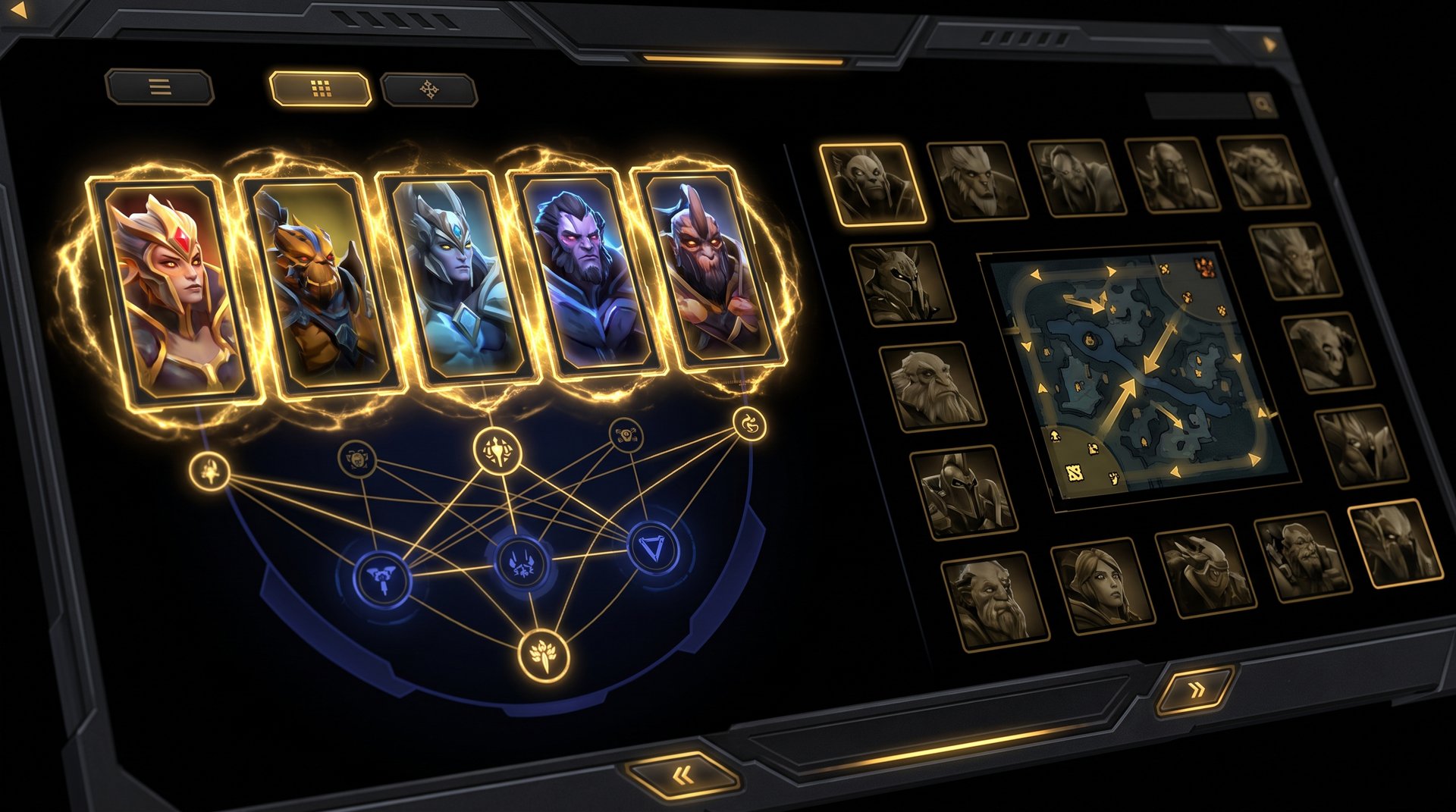
Full Hero Table by Role (Patch 7.41f)
The table below lists the top picks by role for 5-stack party queue. The “Party Lift” column rates how much better the hero gets with full coordination (Low / Medium / High / Tier-Break). Heroes rated Tier-Break are genuinely a different tier in party versus solo.
| Role | Hero | Party WR Range | Party Lift | Key Requirement |
|---|---|---|---|---|
| Pos 1 | Ursa | 55-57% | Medium | 1 hard disable in front of him |
| Pos 1 | Terrorblade | 54-56% | High | Pos 4/5 dedicated peel |
| Pos 1 | Anti-Mage | 53-55% | Medium | Supports to create space early |
| Pos 1 | Spectre | 54-57% | High | Team that wins 3v5 while Spectre farms |
| Pos 2 | Magnus | 56-59% | Tier-Break | Pre-agreed Skewer + RP target call |
| Pos 2 | Templar Assassin | 55-57% | Medium | Pos 4 followup on blink engages |
| Pos 2 | Puck | 54-56% | High | Team to follow Phase Shift-Coil timing |
| Pos 2 | Invoker | 53-56% | Medium | Agreed spell rotation callouts |
| Pos 3 | Tidehunter | 57-60% | Tier-Break | Smoke setup + instant follow burst |
| Pos 3 | Enigma | 57-61% | Tier-Break | Black Hole silence cover from team |
| Pos 3 | Axe | 55-57% | High | Blink + Call timing with burst followup |
| Pos 3 | Underlord | 54-56% | Medium | Fiend Gate rotation awareness |
| Pos 4 | Earthshaker | 55-58% | Tier-Break | Creep clump calls for Echo Slam |
| Pos 4 | Clockwerk | 54-57% | High | Cog traps with agreed burst timing |
| Pos 4 | Rubick | 54-57% | High | Called spell steals for combo chains |
| Pos 4 | Bounty Hunter | 53-55% | Medium | Track gold distribution calls |
| Pos 5 | Io | 58-63% | Tier-Break | Rehearsed Relocate + tether TP routine |
| Pos 5 | Witch Doctor | 55-57% | Medium | Positioning for Death Ward channel |
| Pos 5 | Crystal Maiden | 54-57% | High | Full peel during Freezing Field |
| Pos 5 | Ancient Apparition | 53-56% | High | Called kill timings on shatter targets |
Party WR Range: community aggregator estimate from Stratz and D2PT, patch 7.41f 5-man party matches, Divine+ bracket, October 2026. These are ranges, not single-match precision figures.
Best Carry Heroes for 5-Stack (Pos 1)
Ursa — Buffed in 7.41f, Protected in 5-Stacks
Ursa received direct attack-damage buffs in patch 7.41f, making his Fury Swipes stack damage higher earlier. In solo queue, Ursa’s weakness is getting chain-disabled before he can reach the target. In a 5-stack, your pos 4 plays specifically to eat that disable with Lotus Orb, Force Staff, or a stun of their own. Ursa’s damage ceiling when protected is among the highest physical-damage outputs in the game under 30 minutes. Pick him when your 5-stack runs a Clockwerk or Earthshaker pos 4 who can intercept the disabler while Ursa kills the carry.
Terrorblade — The Protected Scaling Carry
Terrorblade’s illusion-based playstyle makes him one of the game’s hardest carries to protect in solo queue — supports keep running in front of illusions or abandoning him to ganks. In a 5-stack you simply assign one support to stay within peel range. The result is a hero who can comfortably win the farm battle through split pushing while the rest of the team applies pressure. His Sunder ability also creates an emergency escape that your team can plan around: if Terrorblade is threatened, the whole team groups for the Sunder-TP combination.
Spectre — The 5-Stack Long Game
Spectre in solo queue requires your team to win 4v5 for 30 minutes while you farm. In a 5-stack, you recruit people to that brief explicitly — they agree beforehand that their job for the first 25 minutes is to extend the game without dying. Spectre’s Haunt is a game-ending team fight ultimate when the team coordinates around it: your four teammates should be in position to follow Spectral Form before the button gets pressed. In solo queue that coordination is improvised. In a 5-stack it is rehearsed.
Best Mid Heroes for 5-Stack (Pos 2)
Magnus — The Quintessential 5-Stack Mid
Magnus is the single hero most transformed by party queue. Reverse Polarity is a game-winning ultimate that requires three conditions: the enemy team is clustered, your team is ready to burst them, and Magnus survives long enough to cast it. In solo queue, condition two almost never happens — teammates are scattered, buying items, or just not watching. In a 5-stack you call “RP in 3 seconds” on Discord and your team collapses. Magnus also provides Skewer, which has a crucial role in 5-stack play: you can Skewer a carry into your team’s waiting burst, essentially running a guaranteed kill with voice communication.
Magnus in the offlane is equally valid for 5-stacks but the mid role gives him a faster Blink Dagger timing, which is the stat that controls when you can start executing combos. Pair Magnus mid with a Tidehunter offlane for a double-AoE stun combination that wins teamfights mechanically.
Templar Assassin — Individual Skill, Team Enabler
Templar Assassin is rated among the strongest mid laners in patch 7.41f per community tier list data, and she does not need coordination to farm and kill. What coordination gives her is assassination timing: your pos 4 calls when an enemy is walking past river ward vision, TA blinks for the kill, the team collapses if it is not a clean kill. The upgrade is not mechanical — TA works solo. The upgrade is not wasting the Psi Blades-Meld burst because your team sets up the engagement. She also benefits significantly from Magnus Skewer, which clusters targets directly into her Psionic Trap field.
Puck — Dream Coil as a Team Setup
Puck’s Dream Coil is a team-fight control ultimate that punishes positioning errors. In solo queue, enemies pull in opposite directions and the coil triggers kills randomly. In a 5-stack, your team waits for the coil to drop and immediately burst the most valuable target before anyone breaks it. Puck’s Phase Shift timing — when to dodge which ability — also benefits from teammates calling out enemy spell usage, since Phase Shift has a short window and is easy to mis-time in a chaotic solo queue teamfight.
Best Offlane Heroes for 5-Stack (Pos 3)
Tidehunter — Ravage Requires Follow-Up
Tidehunter is the first name any experienced 5-stack player writes down. His Ravage stuns every enemy in a massive radius for 2.02 seconds — and 2.02 seconds is approximately the time it takes for a coordinated team to expend every targeted ability in their rotation. In solo queue, Ravage lands and teammates are out of position, farming elsewhere, or using abilities at random. In a 5-stack, Ravage is a scripted event: smoke in together, Tidehunter presses R, everyone dumps abilities in the agreed priority order. Tidehunter received modest armor buffs in 7.41f that extend his survivability window.
Enigma — Black Hole is Unplayable Without Comms
Enigma’s Black Hole has the highest upside of any ultimate in the game and the hardest execution requirement: it must be channeled for 4 seconds while the enemy team attempts to interrupt it. In solo queue, the channel almost never completes at high MMR — the enemy always has a silence, a BKB-piercing disable, or a blink to get out. In a 5-stack, your team brings Bane (Nightmare on the disabler), Rubick (Silence), or Lionized lockdown to protect the channel. Enigma is genuinely a tier-break hero in party queue. His Eidolons also require micro attention that party queue frees up — instead of managing Eidolons AND coordinating with strangers, you just manage Eidolons while teammates play around your timings.
Axe — Instant Kill Confirmation
Axe’s Culling Blade execution cooldown is 6 seconds on a single target, and the damage threshold is visible to your entire team. In party queue with voice, you call the HP threshold out loud and your team knows exactly when to stop burst so Culling Blade executes cleanly. This prevents the notorious solo queue Axe problem: teammates blowing the kill before Culling Blade can trigger, wasting the reset. The Berserker’s Call also benefits directly from team coordination — your ranged heroes should always know when the Call lands so they immediately hit the forced-combatants.
Best Pos 4 Heroes for 5-Stack
Earthshaker — Echo Slam is the Voice-Comms Ability
Echo Slam’s damage multiplies with every unit near its initial target — two enemies become good, five enemies become game-ending. The way you consistently hit Echo Slam on five enemies in party queue: your team stops disengaging when enemies cluster. In solo queue, teammates run from a Ravage, breaking the clump. In a 5-stack, you call “hold position, Earthshaker incoming” and everyone stacks the fight rather than running. Echo Slam is statistically one of the highest-damage ultimates in the game on a per-mana-spent basis when it hits a clumped fight. Getting that clump is a communication task, not a mechanical one.
Clockwerk — The Guaranteed Initiator
Clockwerk’s Battery Assault and Cogs allow him to isolate one enemy while your team collapses. In party queue, you agree beforehand: “when Clockwerk jumps, everyone moves.” The Cog trap is also a coordination ability — your ranged heroes need to position outside the Cogs and the target needs to be inside. Clockwerk is low-skill-floor relative to his coordination ceiling, making him ideal for 5-stacks where one person plays the hero but the whole team enables the value.
Rubick — Spell Steal Chains with Communication
Rubick’s Spell Steal becomes dramatically more valuable when your team knows what spell he has stolen. After stealing Ravage, Black Hole, or Reverse Polarity, Rubick calls it and the team repositions for the follow-up. Solo queue Rubick is uncertain; 5-stack Rubick builds around “Rubick has stolen X, let’s use it in the next fight.” He also brings Grand Magus Phase — a short window where he can steal multiple spells, requiring teammates to understand what that means for the next engagement.
Best Pos 5 Hard Supports for 5-Stack
Io — 5-Stack Only Hero
This cannot be overstated: Io is not a viable pick in most solo queue contexts below Immortal bracket. Its Relocate ability — teleporting a tethered ally and returning them to their original location after a delay — requires the tethered ally to know this is happening, adjust their position, and execute a play during the window. That is a rehearsed sequence that cannot be improvised with strangers. In a 5-stack, Io goes from “troll pick” to the highest-ceiling pos 5 in the game. Common party queue Io play: Io tethers Ursa, relocates to a helpless target, kills it, returns to base for a fast item timing. This is not a solo queue play. It is a party queue game plan. Io also provides Overcharge during tether for significant attack speed and damage mitigation — directly benefiting protected carry heroes like Terrorblade and Spectre.
Witch Doctor — Best Solo and Party Winrate in 7.41f
Witch Doctor at 55.2% winrate is the statistically strongest support in patch 7.41f (Batru.gg, 6.8 million ranked matches). His combination of laning aggression via Maledict and teamfight closing via Death Ward works at every MMR bracket. While he does not have a massive party-lift differential like Io or Enigma, he is the most consistent floor — he does not require complex coordination to deliver value, meaning your less mechanically precise 5-stack compositions still get strong support value. Death Ward’s channel does benefit from team protection, which is the one area where party queue upgrades him.
Crystal Maiden — Freezing Field Requires Peel
Freezing Field is one of the highest-damage AoE teamfight ultimates in the game on its 10-second full channel — but Crystal Maiden has no escape mechanism and will die if anyone reaches her during the channel. In solo queue, she gets killed in the first second. In a 5-stack, you assign a dedicated peeler (Clockwerk, a Force Staff carrier, Axe with Berserker’s Call to pin the assassin) and Crystal Maiden channels to completion. When a Freezing Field channels for 6+ seconds, the game usually ends. The pick is high-variance in solo queue and extremely reliable in party queue.
Ancient Apparition — Kill Timing Communication
Ancient Apparition’s Ice Blast prevents healing and kills any enemy below 10% HP instantly on shard expiry. The power play: call out Ice Blast targets in voice and have your team stop burst damage at 12-15% HP to guarantee the shard kill rather than accidentally killing the target without the instant death trigger. In solo queue, teammates kill the target at 20% and the shard does nothing. In party queue, you agree on the play and execute it. AA also counters healing compositions and Spectre, making him a direct meta answer in patch 7.41f where Spectre is a top carry pick.
Killer 5-Stack Combos for Party Queue
The Classic: Magnus + Tidehunter Double Stun
Magnus (mid) and Tidehunter (offlane) each have a multi-hero stun ultimate. The sequence: Magnus blinks, Reverse Polarity pulls enemies into a cluster, Tidehunter casts Ravage the instant RP ends (or overlaps). The enemy team is stunned for a combined 4+ seconds with no gap. Your three remaining heroes — any combination of burst damage — cannot realistically fail to kill three targets in 4 seconds if they are ready. This is the signature 5-stack “instant win teamfight” composition in patch 7.41f. Run it with a right-click carry like Ursa or Anti-Mage and a pos 5 that survives long enough to peel.
The Protect the Baby: Io + Spectre
Io tethers Spectre for the first 20 minutes, using Relocate for efficient farm and Overcharge to make Spectre unkillable in skirmishes. Spectre hits level 25 and the Haunt-Reality rotation wins fights automatically. This is a 40-minute game-plan composition that requires every player to understand their role in sustaining the early game. It does not work without explicit agreement — in solo queue, nobody signed up to play a protective role for 20 minutes. In a 5-stack, that is the agreed strategy from hero selection.
The Smoke Stack: Earthshaker + Magnus + Any Carry
Smoke in as five. Magnus Skewers the enemy carry into your team. Earthshaker Fissure cuts off the escape route. Magnus Reverse Polarity follows the Fissure. Earthshaker Echo Slam inside the RP cluster. This sequence eliminates the enemy carry before any teamfight officially starts. The coordination requirement is high: Skewer direction, Fissure placement, and RP timing must be called in real time. In a practiced 5-stack, this three-ability sequence is drilled before ranked games begin.
The Black Hole Stack: Bane + Enigma + Burst
Bane’s Nightmare on the enemy disabler (typically their BKB-carrier) gives Enigma enough window to channel Black Hole. Your three remaining heroes — Storm Spirit, Leshrac, Zeus — have pure-damage burst that does not require a target to be out of Black Hole. The call is simple: Bane uses Nightmare, Enigma presses R, everyone dumps damage. Enigma’s full 4-second Black Hole kills most non-BKB targets through pure damage accumulation. Refer to the counter-smurf tempo draft guide for how this composition adapts when the enemy team runs smurf-level players who pre-buy BKB specifically against Enigma.
Draft Strategy for Party Queue Ranked
The single most common 5-stack mistake is drafting five individually strong heroes instead of drafting around one win condition. Party queue lets you execute a win condition reliably — but only if you agreed what that condition is before the draft starts.
Pick Your Win Condition First
Before the draft, answer: “How do we win teamfights?” One answer and one answer only. Either you have the AoE stun comp (Magnus + Tidehunter), the Black Hole comp (Enigma + Bane), the pick-off comp (Clockwerk + Axe), or the protect-the-carry comp (Io + Spectre/TB). Each of these is a complete game plan. Mixing two game plans is what solo queue teams do by accident — 5-stacks do it on purpose and still wonder why the teamfights are chaotic.
Assign Anti-Disable Before Drafting
The enemy team will draft a BKB user, a silence, or a Black King Bar-piercing stun specifically to counter your combo. Before locking your fifth hero, designate one player to buy Lotus Orb or one hero to be the combo-protector. Rubick stealing the silence, Clockwerk Cogwheeling the disabler away, or Bane Nightmaring the BKB carry — this role needs to be assigned, not improvised.
Sync Your MMR Ranges
Valve’s 5-stack ranked restrictions mean that not every MMR combination can queue together. Players with large MMR gaps cannot form a party for ranked games. Check the current 5-stack MMR rules before building your lineup. If your party has a 2,000+ MMR spread, you may be forced into a different queue mode, which changes the hero pool in a meaningful way (lower average MMR means less BKB timing awareness, more punishable AoE stun landing). For parties that need to close an MMR gap before they can queue together, our MMR boosting service is the fastest route — targeting a specific number to unlock a party queue composition is a common order type.
For 2-stack coordination strategies, the two-stack role pairing guide covers the transitional phase between solo queue and full 5-stack play — specifically which role combinations deliver the most MMR before a full team is available.
Common 5-Stack Mistakes (and How to Fix Them)
Frequently Asked Questions
Unlock Your Party Queue MMR Ceiling
These heroes and combos are designed for coordinated 5-stacks. If your party needs an MMR boost to reach the right bracket — whether that is matching with a higher-rated friend or targeting a calibration floor — TeamSmurf handles Dota 2 ranked boosting exclusively. No account sales, no sketchy marketplaces. MMR boosting, calibration services, low-priority removal, and coaching only.


