


Invulnerable vs Debuff Immune vs Banished vs Ethereal: Dota 2 States Explained

Four different states in Dota 2 can protect you from damage or targeting — but each one works differently. Invulnerable means nothing can touch you. Debuff immune blocks most magical spells but not physical attacks. Banished lifts you out of reach but does not protect you from area damage. Ethereal stops physical attacks completely while making you more vulnerable to magic.
Knowing which state does what is not trivia — it decides whether you panic-buy Ghost Scepter or BKB, whether Doom should be cast before or after an enemy pops a defensive item, and which heroes can answer a quiz question like “which hero can become invulnerable?” with a real answer instead of a guess.
This page covers all four states for patch 7.41f: what applies them, what can hit through them, and where players most often get the interaction wrong.
Table of Contents
Quick Comparison: All Four States Side-by-Side
Before diving into details, here is the one-glance answer. Every row answers the question “does this affect you while in this state?” Verified for Dota 2 patch 7.41f.
| What tries to hit you | Invulnerable | Debuff Immune | Banished | Ethereal |
|---|---|---|---|---|
| Physical attacks (right-clicks) | Blocked | Hits normally | Blocked (untargetable) | 0 damage |
| Magical spell damage | Blocked | Mostly blocked | Ground AoE may still hit | Hits (+40% amp) |
| Pure damage | Blocked | Hits normally | Ground AoE may still hit | Hits normally |
| BKB-piercing abilities | Blocked | Hits (these bypass it) | Blocked if targeted | Hits normally |
| Ongoing DoTs (poison, burn) | Paused | Continues | Paused (most sources) | Continues |
| Can you cast abilities? | No | Yes | No | Yes |
| Can you move? | No (most sources) | Yes | No | Yes |
| Can enemies target you? | No | Yes | No | Yes |
| Can you deal attack damage? | No | Yes | No | 0 damage |

Invulnerable: Complete Protection From Everything
Invulnerable is the strongest protection state in Dota 2. When a unit is invulnerable, it cannot be targeted by any ability or attack, and it takes zero damage from any source — physical, magical, or pure. Nothing interacts with you while you are in this state.
What the Invulnerable State Does
In patch 7.41f, the invulnerable state enforces the following rules:
- Cannot be targeted. No single-target ability, attack, or item active can select you as a target. The cursor will not lock onto an invulnerable unit.
- Immune to all damage types. Physical attacks deal zero. Magical spells deal zero. Pure damage deals zero. The damage type does not matter — the invulnerable state blocks everything.
- Ongoing damage-over-time effects are paused, not removed. If Venomancer’s Poison Nova was ticking on you before Puck used Phase Shift, those remaining ticks are suspended for the duration of the invulnerability. The moment Phase Shift ends, the ticks resume exactly where they left off.
- BKB-piercing abilities have no effect. Not because of debuff immunity, but because nothing can interact with you at all. Doom’s Doom debuff, Fiend’s Grip, Rupture — none of these land while you are invulnerable. This is the key difference from debuff immune: BKB only stops non-piercing magic, while invulnerable stops everything including piercing spells.
- In-flight projectiles aimed at you are destroyed on entry. With some implementation-specific exceptions, projectiles that were already traveling toward you are cancelled when you go invulnerable.
What Cannot Happen to You While Invulnerable
- Cannot be stunned, slowed, silenced, hexed, or rooted by any new effect.
- Cannot receive new debuffs of any kind.
- Cannot have HP reduced.
- Cannot have mana reduced by most sources.
- Cannot be forcibly displaced by abilities.
- Cannot be killed, even by abilities that state “kills the target immediately.”
Which Heroes Can Become Invulnerable in Dota 2?
This is the exact question quiz-style searches are asking: “among the following heroes, who can become invulnerable?” Here is the accurate list for patch 7.41f:
- Puck (Phase Shift). The most iconic invulnerable ability in the game. Puck stays at its current position and becomes fully invulnerable for up to 3 seconds. The ability can be cancelled manually by pressing it again or by using another ability. Timed correctly, Phase Shift lets Puck sit through a Black Hole, Ravage, or any targeted kill spell with zero damage taken.
- Oracle (False Promise). Oracle’s False Promise ends with a brief invulnerability phase during which all accumulated healing is applied to the target. The target cannot die during this window — even if they were at 1 HP when the ability’s main duration expired, they become invulnerable while the heals resolve. This is what makes False Promise the strongest emergency save in the game.
- Brewmaster (Primal Split). When Brewmaster activates Primal Split, the Brewmaster base unit becomes invulnerable and untargetable for the entire duration. The three spirits (Earth, Storm, Fire) are separate units that can be attacked and killed independently, but the Brewmaster itself cannot be harmed until Primal Split ends or all spirits are destroyed.
- Phoenix (Supernova). During Supernova, Phoenix transforms into an egg. The Phoenix hero unit is invulnerable — all attacks and ability damage are directed at the egg, which has its own separate HP pool. If the egg survives the explosion, Phoenix re-emerges at full HP. If the egg is destroyed, Phoenix dies. Phoenix itself cannot take damage separately from the egg while Supernova is active.
- Meepo (Poof). During the Poof teleportation phase, each Meepo clone is briefly invulnerable as it travels to the target clone’s position. The window is very short, but in-flight projectiles aimed at the traveling Meepo are cancelled during this phase.
Note: several heroes have abilities that remove themselves or allies from play entirely (Disruption, Astral Imprisonment) — those create the banished state, not invulnerable. The distinction matters: invulnerable units remain visible and present on the map, while banished units may be removed entirely depending on the ability.
Common Invulnerable Misconceptions
The biggest mistake: confusing invulnerable with debuff immune. If you activate Black King Bar, you become debuff immune — not invulnerable. You can still take physical attack damage, and pure-damage spells still land. A BKB-active hero can die to a 6-item Phantom Assassin in seconds. A hero in Phase Shift cannot die to anything while the ability is active.
Second mistake: forgetting that DoTs resume after the invulnerability ends. Puck surviving a Black Hole at 50 HP via Phase Shift is good — until Phase Shift ends and the remaining Macropyre or Epicenter ticks finish the job. Always plan the exit route before using Phase Shift: know where you need to be when the window closes.
Debuff Immune: Blocks Most Magic, Physical Attacks Still Land
Debuff immunity is the current in-game term for what was previously called spell immunity. Dota 2 updated its tooltip language to “debuff immunity” to more accurately describe what the state actually does — and the distinction matters. The most common source is Black King Bar (BKB), which is why the community still talks about “BKB-piercing” abilities.
What Debuff Immunity Does
- Blocks most magical debuffs and spell effects. Slows, stuns, silences, hexes, and spell damage from most non-piercing magical abilities cannot land on a debuff-immune unit.
- Does NOT block physical attacks. Right-clicking a debuff-immune hero deals full attack damage. This is the most important practical difference from invulnerable.
- Does NOT block pure damage. Pure damage is a separate damage type that bypasses both magic resistance and debuff immunity. Spells that deal pure damage (Invoker’s Sunstrike against a BKB target, for example) deal their full amount regardless.
- Does NOT block BKB-piercing abilities. This entire category of spells exists specifically to bypass debuff immunity. They are labeled “pierces debuff immunity” in their tooltips for exactly this reason.
- Existing DoTs continue. Unlike invulnerable, debuff immunity does not pause ongoing damage-over-time effects that were already ticking before the state activated.
The list of every ability that pierces debuff immunity is covered in full detail in the companion article: What Pierces BKB in 2026: The Full List. That post has the complete breakdown for patch 7.41f with source verification. This section explains what debuff immunity IS; that post explains what beats it.
Notable Sources of Debuff Immunity
- Black King Bar (BKB). The primary debuff immunity item. Starts at 9 seconds, decreases by 1 second each activation down to a minimum of 5 seconds. After each use, the duration permanently decreases for that item on that hero.
- Blade Fury (Juggernaut). Juggernaut spins and becomes debuff immune for 5 seconds. He can still take physical damage from attacks during Blade Fury and can still move, but cannot use other abilities or items.
- Rage (Lifestealer). Lifestealer gains debuff immunity and increased attack speed for a duration. Physical attacks still hit Lifestealer and he can attack while raged.
Banished: Untargetable but Not Fully Protected
Banished is the state where a unit is lifted, displaced, or removed from normal targeting. It is weaker than invulnerable — the unit cannot be targeted by single-target abilities or attacks, but area-of-effect abilities that are already in place or that do not require targeting can still reach them in some cases.
What the Banished State Does
- Cannot be targeted. Single-target abilities and attacks cannot select a banished unit. The cursor will not lock on.
- Cannot act. Banished units cannot move on their own, attack, cast abilities, or activate items.
- Physical attacks cannot connect. There is no targetable entity to click on.
- AoE spells may still hit. This is the defining difference from invulnerable. Ground-targeted AoE abilities — ones that target a map location rather than a specific unit — can still reach a banished unit if the unit is within the blast area. However, many abilities have a “does not affect banished units” flag, so this is inconsistent across the spell list.
- DoTs are paused in most cases. Eul’s Cyclone, Tornado, Disruption, and Astral Imprisonment all pause existing damage-over-time effects for the duration of the banish. This can be used tactically: cycloning a poisoned ally pauses the ticking if the remaining DoT duration is shorter than the banish window. When the banish ends, the DoT resumes from its remaining duration.
Two Subcategories of Banish
Not all banish effects work identically. The distinction matters for gameplay decisions:
Lift-banish (Eul’s Cyclone, Invoker’s Tornado). The unit is physically lifted above their current position on the map. They remain within the map boundaries. AoE abilities with a large enough radius that were already active — or that target the ground beneath the lifted unit — can still catch them. Examples where a Cyclone target can still take damage: persistent AoE fields like Earthshaker’s Epicenter ticks that were placed before the cyclone, or large-radius ground effects already in progress.
Dimensional-removal banish (Shadow Demon’s Disruption, Outworld Destroyer’s Astral Imprisonment). The unit is removed from the physical map entirely and placed in a separate plane. Nothing can reach them while they are in this state — no AoE, no DoTs, no forced movement. They are unreachable until the ability’s duration ends. This is functionally closer to invulnerable for the purposes of damage prevention, but implemented as a banish state.
Notable Sources of Banished State
- Eul’s Scepter of Divinity (Cyclone). Single-target lift for 2.5 seconds. Usable on self or enemy. Cleanses most debuffs from self when self-cast. The most flexible banish item in the game.
- Invoker’s Tornado. Linear AoE that lifts all units in path for 0.5 to 1.6 seconds depending on Wex level. Multiple units can be banished simultaneously.
- Shadow Demon’s Disruption. Dimensional removal for 2.9 seconds. Target cannot be reached by any ability or attack. Upon return, two illusions of the target spawn at the exit location.
- Outworld Destroyer’s Astral Imprisonment. Dimensional removal for up to 4 seconds. The imprisoned unit cannot act or be harmed. On return, mana is drained from the target and nearby enemies equal to the amount stored during imprisonment.
- Void Spirit’s Astral Step. Void Spirit briefly phases into an astral plane during the dash, becoming untargetable during the traversal window. Short duration but useful for dodging targeted abilities mid-fight.
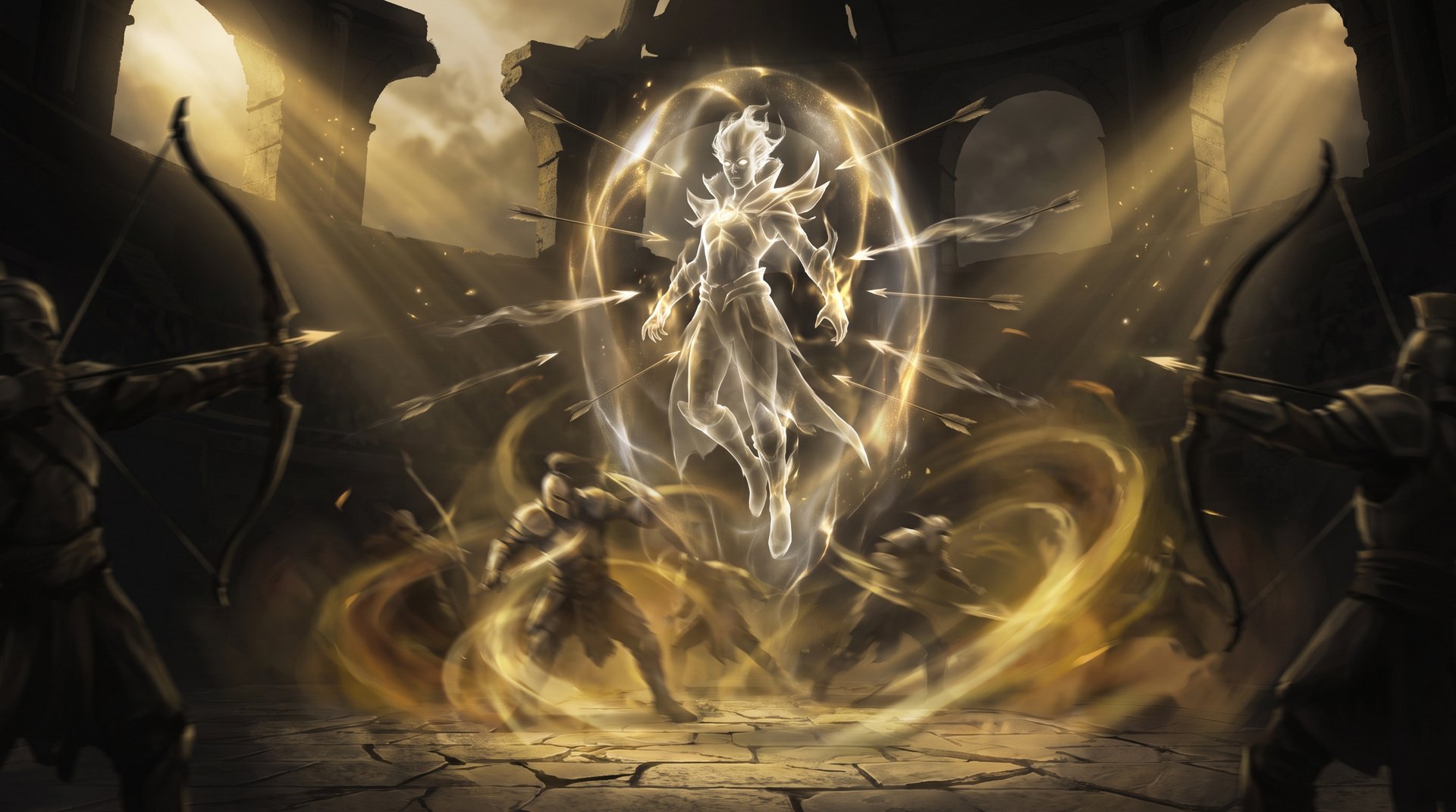
Offensive and Defensive Banish Timing
Eul’s Scepter is one of the most bought items in high-MMR games specifically because of how it interacts with ability timings. On yourself: removes you from a stun or hex that is about to land, pauses a DoT, and buys cooldown time. You cannot be targeted during the 2.5 seconds, which means channeled abilities lose their target, in-flight projectiles cancel, and any setup for the enemy’s follow-up abilities is wasted.
On an enemy: sets up a guaranteed stun or ability landing after 2.5 seconds, removes them from a fight during that window, and pairs with high-cast-time ultimates like Laguna Blade or Thunder Strike that would normally be dodged. Shadow Demon players use Disruption primarily to create the 2.9-second window for their team to position for a kill on the returned target, and to spawn the two illusions for scouting or illusion pressure.
The most common Eul’s mistake: self-casting it with no follow-up available. You spend 2.5 seconds unable to act and then re-enter the fight in the same position, with one less item active. Use it when your team has follow-up within the window, or when dodging a specific ability — not as a panic button to buy seconds when outnumbered with no escape.
Ethereal: No Physical Damage, Increased Magic Damage
The Ethereal state is unique among the four: it does not make you untargetable, it does not prevent all damage, and you can still move and act. What it does is convert your body into a translucent ethereal form — physical attacks pass through you harmlessly, but magical spells hit harder.
What the Ethereal State Does
- Cannot receive physical attack damage. Right-clicks from any hero deal zero damage while you are Ethereal. Attack modifiers that deal physical damage also deal zero.
- Cannot deal physical attack damage. While Ethereal, your own right-clicks deal zero damage to enemies as well. You can attack, but the hits do nothing.
- Takes increased magical damage. Ghost Scepter and Ethereal Blade apply a 40% magic damage amplifier on incoming magical damage. Pugna’s Decrepify applies a higher amplifier (check the tooltip for the current value in patch 7.41f). This amplifier stacks with the target’s existing magic resistance — it amplifies the incoming damage before resistance is applied.
- Pure damage is not amplified. The Ethereal magic amp does not apply to pure damage. Pure damage bypasses magic resistance and deals its listed amount regardless of the Ethereal state.
- Can still be targeted by abilities. Unlike invulnerable and banished, you can be selected as an ability target while Ethereal. Enemies can cast spells on you freely.
- Can still act normally. You can move, cast abilities, activate items, and attack (though attacks deal zero damage). This is a fundamental difference from banished.
Sources of Ethereal State
- Ghost Scepter (item). Self-only, applies Ethereal for 4 seconds. You cannot deal attack damage and cannot take attack damage. 40% magic amplifier applies. Useful when being dove by right-click heavy heroes who have little magical burst.
- Ethereal Blade (item). Can be used on self or an enemy. When used on an enemy, it deals an initial burst of physical damage (this lands before the Ethereal state applies), then the target becomes Ethereal with 40% magic amp. The standard combo: Ethereal Blade the target, then immediately follow with a magical nuke — the target is now Ethereal when the nuke hits, so the nuke deals 40% more damage than normal.
- Pugna’s Decrepify. Applies Ethereal to any unit — ally, enemy, or self. Has a higher magic amp than Ghost Scepter or Ethereal Blade. Used offensively on enemies to set up kills with magical burst, or defensively on an ally being dove by physical carry heroes who have no magical follow-up.
The Ethereal Blade Combo Explained
The reason Ethereal Blade appears in the builds of magical damage carries is the interaction between the physical damage projectile and the Ethereal state that follows. The projectile fires first and deals physical damage — it hits before the target enters Ethereal. Then the Ethereal state applies. Then your magical nuke fires and lands on a target with 40% more vulnerability to magic than normal.
This is why Leshrac, Skywrath Mage, Witch Doctor, and other casters buy Ethereal Blade as a damage amplification item rather than a defensive one. The item does two things in one activation: front-loads physical burst, then sets up amplified magical burst from the rest of your rotation.
When Ethereal Hurts You
Ethereal state on yourself is dangerous against caster-heavy lineups. Ghost Scepter blocks right-clicks while amplifying magical damage by 40%. Against a team with Leshrac, Skywrath Mage, and Shadow Fiend, using Ghost Scepter makes you dramatically more vulnerable to their main damage source. Always check what the primary damage type of the enemy lineup is before deciding to go into Ethereal.
Similarly, if an enemy Pugna Decrepifies you during a teamfight, be aware that your right-click damage is zeroed out for the duration. If you are a physical carry, switch to a different target or use magical abilities during the Ethereal window. Many Herald and Guardian carry players continue right-clicking a Decrepified target for 4 seconds and dealing zero damage, then wonder why the kill did not happen.
The interaction between Ethereal and magic resistance is also commonly misunderstood. See Armor and Magic Resistance Math, Explained Simply for the exact calculation. The short version: 25% base magic resistance and 40% magic amp are not equal and opposite. The amp multiplies the incoming damage by 1.40, and resistance then reduces that amplified number. The net effect is more damage taken than the raw numbers suggest when read separately.
Every Major Source of Each State (Patch 7.41f)
| State | Source | Who It Affects | Duration | Key Notes |
|---|---|---|---|---|
| Invulnerable | Phase Shift (Puck) | Self | Up to 3s | Can be cancelled manually; DoTs resume on exit |
| Invulnerable | False Promise (Oracle) | Ally | Brief heal window | Target cannot die during this window |
| Invulnerable | Primal Split (Brewmaster) | Self (base unit) | Duration of Primal Split | Spirits are separate units, not invulnerable |
| Invulnerable | Supernova (Phoenix) | Self | Duration of Supernova | Egg has separate HP; if egg dies, Phoenix dies |
| Debuff Immune | Black King Bar | Self (item) | 9s decreasing per use (min 5s) | Physical attacks and BKB-pierces still land |
| Debuff Immune | Blade Fury (Juggernaut) | Self | 5s | Cannot cast other abilities; physical attacks land |
| Debuff Immune | Rage (Lifestealer) | Self | 5s | Gains attack speed; physical attacks land |
| Banished (lift) | Eul’s Scepter (Cyclone) | Self or enemy | 2.5s | Cleanses self; AoE ground effects may hit |
| Banished (lift) | Tornado (Invoker) | AoE enemy | 0.5–1.6s | Multiple units simultaneously; AoE may hit |
| Banished (removal) | Disruption (Shadow Demon) | Enemy | 2.9s | Fully removed from map; spawns 2 illusions on return |
| Banished (removal) | Astral Imprisonment (OD) | Self, ally, or enemy | Up to 4s | Fully removed; mana drained on return |
| Ethereal | Ghost Scepter | Self (item) | 4s | 40% magic amp; self-only |
| Ethereal | Ethereal Blade | Self or enemy (item) | 4s | Physical damage burst before Ethereal applies; 40% magic amp |
| Ethereal | Decrepify (Pugna) | Any unit | 4s | Higher magic amp than Ghost Scepter or E-blade |
Common Interaction Mistakes by State
Invulnerable Mistakes
Assuming BKB makes you invulnerable. This is the most common conceptual error in pub Dota. Black King Bar gives debuff immunity. Physical attack damage still lands. Pure damage still lands. BKB-piercing abilities still land. Invulnerable means nothing touches you — Phase Shift level protection, not BKB level protection.
Forgetting DoTs resume on exit. Phase Shift at 50 HP to survive Black Hole is smart. Dying immediately when Phase Shift ends because Macropyre ticks resume is preventable. Know how many DoT ticks are still pending and plan your exit position accordingly. If you know Venomancer’s ultimate has 3 ticks remaining, use Phase Shift to survive them, then exit into a safe position before Phase Shift ends.
Debuff Immune Mistakes
Reactive BKB activation. If the Hex lands before you pop BKB, BKB does not remove the Hex. It only blocks new debuffs from landing. This is one of the most teachable mechanical habits in Dota 2 and one of the clearest indicators of bracket. Above 5,000 MMR, players use BKB proactively almost universally. Below 3,000 MMR, reactive BKB is extremely common.
Over-relying on BKB in physical carry matchups. Against a lineup of Phantom Assassin, Ursa, Troll Warlord, and a physical support, BKB does almost nothing for your survivability. The item is designed for magical control, not physical damage reduction. Build armor, evasion, or HP instead for physical carry matchups.
For the full context of what BKB-piercing abilities exist and how to build around them, see the dedicated article: What Pierces BKB 2026.
Banished Mistakes
Eul’s as a solo escape button with no follow-up. Self-cycloning while outnumbered with no teammate nearby buys 2.5 seconds and accomplishes nothing else. You return to the same position, unable to act for those 2.5 seconds, with a 23-second cooldown spent. Use Eul’s when there is a specific ability to dodge or a teammate in position to follow up.
Assuming all banish types are equal. An ally in Disruption cannot be reached by anything. An ally in Eul’s Cyclone might take damage from a large-radius AoE field that was already placed under them. Know which banish type is on the target before assuming they are completely safe.
Ethereal Mistakes
Right-clicking an Ethereal target. Every single attack during Ethereal state deals zero physical damage. This is dead button-pressing. Switch targets, use magical abilities, or wait for Ethereal to expire before resuming right-click damage.
Ghost Scepter into a caster-heavy lineup. Ghost Scepter amplifies incoming magic damage by 40% while blocking physical attacks. Against a team with three magic damage casters, this item is a net negative for your survivability. Check the enemy damage profile first. Ghost Scepter is strong against Phantom Assassin, Ursa, Troll Warlord — heroes that kill you through right-clicks.
Understanding these mechanics is what separates players who die to “unfair” abilities from players who saw the combo coming, knew which state they needed to be in, and itemized for it. If you want to accelerate this process with live in-game feedback, Dota 2 boosting services and coaching both provide the high-MMR perspective. The difference is coaching builds the reads permanently; boosting provides the rank without the mechanic foundation. For a detailed look at which approach fits your goals, see the overview of what Dota 2 boosting involves.
Magic Resistance vs Ethereal Amplification: The Interaction
One point that consistently confuses players reading patch notes or watching pro games: magic resistance and the Ethereal magic amplification are not simply added or subtracted from each other. They interact multiplicatively.
Base setup: most heroes have 25% magic resistance, meaning a 400-damage magical spell deals 300 damage to them after resistance. Now apply Ethereal with 40% magic amp: the incoming 400-damage spell is amplified to 560 before resistance applies, and then 25% resistance reduces it to 420 damage. The result is 40% more damage than the raw 300 you would take without Ethereal.
This is why Ethereal Blade combos on casters output more burst damage than players expect from reading tooltips alone. The amp stacks multiplicatively with resistance, not additively. For the full breakdown of how armor and magic resistance formulas work in patch 7.41f, the Armor and Magic Resistance Math guide walks through every step.
Want to Apply These Reads in Ranked Games?
Understanding protection states is step one. Applying the timing reads under pressure — BKB before the stun, Phase Shift through the Black Hole, Ghost Scepter against the right lineup — is where MMR actually comes from. Our coaches play at 8,000+ MMR and work specifically on mechanical decision timing, including protection state usage, item timing, and ability sequencing.



