

Battle Cup Tiers vs MMR: How Your Battle Cup Tier Is Set

Every time Battle Cup registration opens, the same question floods the Dota 2 community: “What tier will I be placed in?” The answer is straightforward — Valve reads your current ranked MMR and places you into the corresponding bracket. But the details matter. Which MMR puts you into which tier? Can you ever enter a higher tier than your MMR allows? And critically, does any of this affect your ranked medal?
This guide answers all of it. You will find the full eight-tier MMR table, a plain explanation of how Valve assigns tiers, a breakdown of what you actually gain from Battle Cup (and what you do not), and the most common misconceptions that trip players up at registration.
If you are here just to find out whether Battle Cup losses cost you MMR, the short answer is no — they do not. But the longer answer involves understanding exactly how Battle Cup is separated from ranked play, which this guide covers in full. If you want to know how to register and the tournament format itself, check the Battle Cup season guide for the event logistics.
Table of Contents
- How Valve Sets Your Battle Cup Tier
- The Full MMR Bracket Table: All 8 Tiers
- Battle Cup Tier vs Your Ranked Medal
- Does Battle Cup Affect Your Ranked MMR?
- Does Losing in Battle Cup Hurt Your MMR?
- What Is Battle Cup Actually Worth?
- Can You Play in a Higher Tier Than Your MMR?
- How to Move Up a Tier
- Battle Cup Carry: Winning Your Tier
- Frequently Asked Questions
How Valve Sets Your Battle Cup Tier
Valve determines your Battle Cup tier using a single input: your current ranked MMR at the moment your team registers. There is no separate Battle Cup rating, no adjustment based on your Battle Cup history, and no averaging of peak versus current MMR. Whatever your ranked matchmaking number reads at registration time is what Valve uses to assign your bracket.
The assignment happens automatically. When the captain registers a five-player team, Valve checks each player’s ranked MMR individually. Every player is placed into the tier that corresponds to their own MMR, and the team competes in the bracket of the captain — or, depending on the active event’s rules, the bracket determined by the highest or average MMR on the team. In most standard Battle Cup formats, the team bracket is set by the captain’s MMR tier.
The Calibration Snapshot
One detail that trips players up: Valve takes the MMR snapshot at the point of registration, not at match start. If you play ranked games between registering and your first match, your MMR can change — but your Battle Cup tier will not change for that event. The tier is locked at registration.
This matters if you are sitting right at a bracket boundary. A player at 2,920 MMR who plays a few ranked games before the tournament begins could theoretically cross into Legend (2,925+) — but their Battle Cup bracket was already set at Archon when they registered. The tier does not update mid-event.
Conversely, a player who drops below a threshold after registering also does not get moved down. The snapshot is final for that Battle Cup weekend.
Ranked MMR Requirement
Battle Cup uses ranked MMR specifically — not behavior score, not Turbo wins, not unranked performance. Players who have not completed their ranked calibration games technically have no ranked MMR on record. In practice, Valve will often use their estimated MMR from calibration or place them in the lowest available tier (Herald), but the intended system requires completed ranked calibration for accurate placement.
If you are playing your first few Battle Cup events and your account is recently calibrated, you may find your placement feels slightly off — this is normal and corrects itself as your ranked MMR stabilizes over more games.
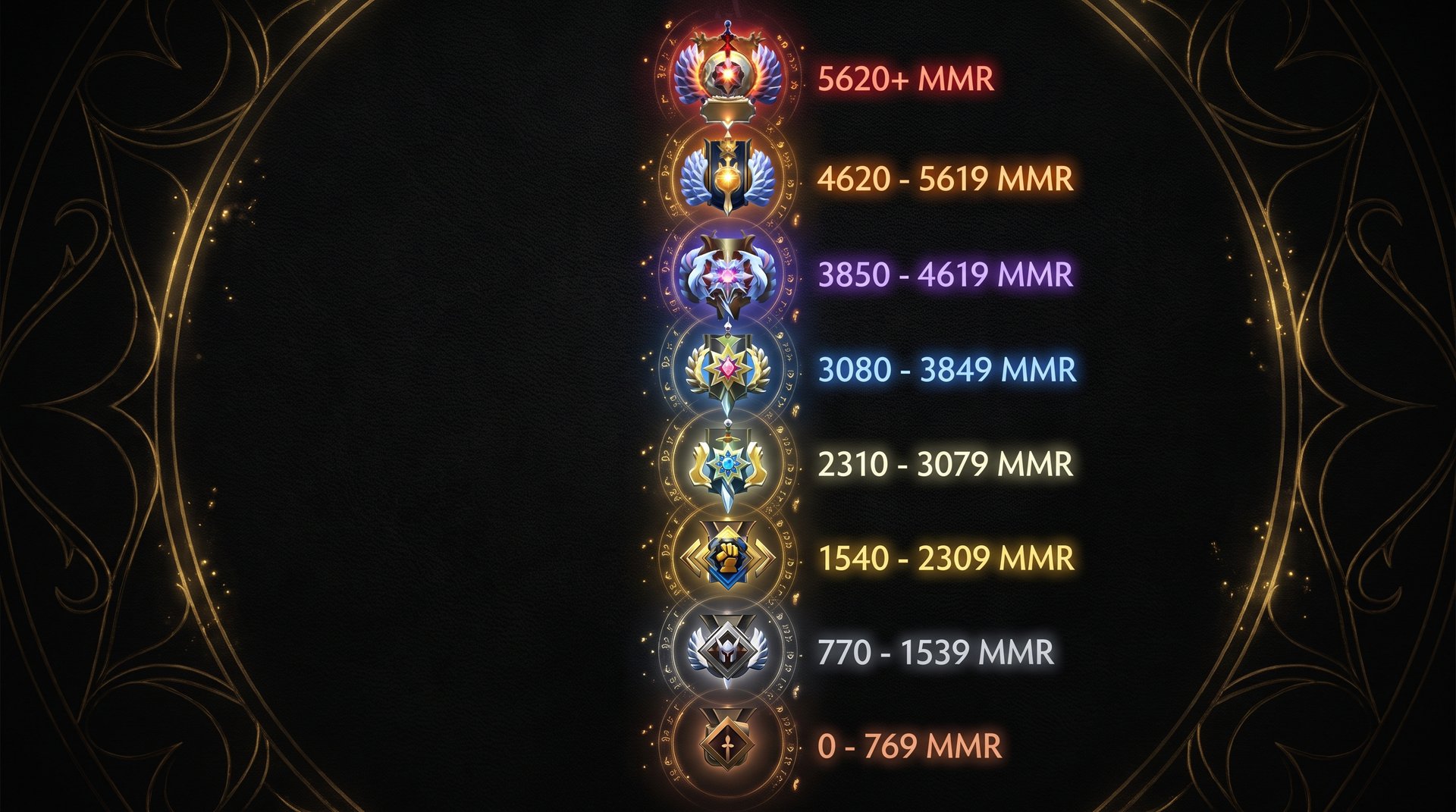
The Full MMR Bracket Table: All 8 Tiers
Dota 2 has eight ranked medal tiers, and Battle Cup mirrors this structure with a corresponding eight-tier bracket system. Each tier spans roughly 770 MMR, divided into five stars within each medal. The table below shows the approximate MMR range for each tier based on current Valve matchmaking data and community-tracked sources including Dotabuff and Stratz aggregate data.
| Battle Cup Tier | Ranked Medal | Approximate MMR Range | MMR per Star |
|---|---|---|---|
| Tier 1 | Herald | 0 — 616 | ~154 MMR |
| Tier 2 | Guardian | 617 — 1,386 | ~154 MMR |
| Tier 3 | Crusader | 1,387 — 2,155 | ~154 MMR |
| Tier 4 | Archon | 2,156 — 2,924 | ~154 MMR |
| Tier 5 | Legend | 2,925 — 3,693 | ~154 MMR |
| Tier 6 | Ancient | 3,694 — 4,462 | ~154 MMR |
| Tier 7 | Divine | 4,463 — 5,420 | ~192 MMR |
| Tier 8 | Immortal | 5,421+ | No upper limit |
Reading the Table: Where You Actually Fall
The most common confusion is around the exact boundary. If your MMR is 2,924 you are Archon (Tier 4). If it is 2,925 you are Legend (Tier 5). There is no gray zone — the cutoff is hard. This is why some players feel they are “borderline” heading into Battle Cup registration and want to either push over the next threshold or stay below it (for easier competition in the lower tier).
The star within each tier also matters for your personal ranked medal display, but for Battle Cup purposes, Valve groups the entire medal range together. An Archon 1 and an Archon 5 are in the same Battle Cup bracket — Tier 4. The star distinctions that make such a visible difference in ranked play disappear inside Battle Cup, where the entire medal is treated as a single competitive pool.
Divine and Immortal: Why the Numbers Feel Different
You will notice Divine’s MMR span (4,463 to 5,420) is slightly wider than the lower brackets. This reflects Valve’s historical approach of giving more room at the top of the medal ladder before the Immortal transition. Divine 5 players at 5,400 MMR and Divine 1 players at 4,463 are in the same Battle Cup tier but have nearly 1,000 MMR between them — which creates notably varied skill levels within Tier 7 brackets.
Immortal (Tier 8) has no upper cap. Whether you are at 5,421 MMR or 13,000+ MMR like the top-ranked players, you compete in the Immortal Battle Cup bracket. The practical effect is that Immortal Battle Cup is effectively a mini-pro-level tournament — the quality of play is orders of magnitude above Tier 1 or 2 events.
Battle Cup Tier vs Your Ranked Medal: Key Differences
Battle Cup tiers and ranked medals share the same underlying MMR system, but they are not the same thing in practice. Here is where they differ in ways that matter to players:
Medals Are Displayed Permanently; Battle Cup Tiers Are Per-Event
Your ranked medal is a persistent display that updates over the course of a season and follows you from game to game. Your Battle Cup tier exists only for the duration of that specific weekend event. Every new Battle Cup weekend, Valve re-reads your current MMR and re-assigns your tier. If your MMR improved since the last event, your tier goes up. If it dropped, your tier goes down.
Medals Have a Shield (Peak Protection); Battle Cup Does Not
Dota 2 ranked medals have a peak MMR protection system — your displayed medal badge reflects your highest MMR reached in a season, even if you drop below it later. Battle Cup does not use peak MMR. It reads your current MMR at registration, not your season peak. A player who hit Ancient 2 peak but has dropped back to Legend 5 at registration time will compete in the Legend Battle Cup bracket (Tier 5), not Ancient (Tier 6).
This is a frequently misunderstood distinction. If you see a player with an Ancient medal badge but they are in your Legend bracket, they peaked at Ancient but their current MMR has them in the Legend range. Battle Cup is honest about where you actually are right now.
Starred Distinction Matters in Ranked, Not in Battle Cup
In ranked matchmaking, a Crusader 4 and a Crusader 1 are matched differently — the system tries to keep star levels close within the same bracket. In Battle Cup, both are Tier 3 (Crusader) and share the same bracket pool. This does create some skill variance within tiers, but it is intentional — Battle Cup brackets need enough players to fill a tournament, and subdividing by star would fragment the pool too much in smaller regions.
Does Battle Cup Affect Your Ranked MMR?
No. Battle Cup results have zero impact on your ranked MMR. This is not a technicality or an edge case — it is a core design decision Valve made when building the Battle Cup system. Wins, losses, and even disconnects in Battle Cup do not write any value to your ranked matchmaking rating.
The ranked and Battle Cup systems are entirely separate. A win in Battle Cup does not add 25 MMR. A loss does not cost you 25 MMR. Your rank progression — everything tied to your medal and your matchmaking rating — operates on a completely independent track from Battle Cup outcomes.
This separation is what allows Battle Cup to function as a weekly tournament that anyone can enter repeatedly without fear. If Battle Cup results affected ranked MMR, players would face the same psychological stakes as ranked games, and the event would become as stressful as a ranked session rather than a structured competitive outlet.
For a comprehensive look at which game modes do and do not affect your MMR — including Turbo, Ability Draft, and seasonal events — the breakdown is covered in detail in our MMR boosting guide. The short version: ranked is the only mode where your MMR on record changes. Everything else, including Battle Cup, is a consequence-free competitive experience from an MMR standpoint.
Does Losing in Battle Cup Hurt Your Ranked MMR?
No. Losing in Battle Cup, even getting eliminated in the first round, has no effect on your ranked MMR. You can go 0-2 and get knocked out in the first round of every Battle Cup for an entire month without moving your ranked MMR a single point in either direction.
The same applies to disconnects, early leaves, and team forfeits. None of these Battle Cup outcomes feed into the ranked system. Your ranked medal and ranked MMR are untouched by anything that happens inside a Battle Cup bracket.
Why This Matters for How You Approach Battle Cup
The zero-MMR-consequence design of Battle Cup changes how you should think about entering it. Because a loss costs you nothing in ranked terms, Battle Cup is the ideal place to:
- Try heroes you do not normally play in ranked. If you queue Invoker in ranked and perform poorly, that costs you MMR. If you try Invoker in Battle Cup Captain’s Mode and your team picks it for you, the loss has no ranked consequence.
- Practice Captain’s Mode drafting. The draft phase in Captain’s Mode is a different game from All Pick. Every ban and pick reveals information. Learning this without MMR stakes is valuable preparation for tournament-style thinking.
- Play with friends who are slightly above or below your MMR. Since Battle Cup brackets are based on the captain’s tier, your group can coordinate around a single captain and compete together. The cost of a bad outcome is cosmetic loss, not a medal drop.
- Explore aggressive, high-risk drafts. In ranked, playing a greedy draft that can lose hard is a liability. In Battle Cup, if the gamble does not pay off, you lose the match and nothing else.
The bottom line: treat Battle Cup as practice with stakes that matter for skill development and cosmetics, not for your ranked MMR. That is the mental model that makes it most valuable.
What Is Battle Cup Actually Worth?
Battle Cup does not move your ranked MMR. So what is the actual incentive to participate? There are three distinct categories of value, and how much you weight each depends on what you want from the game.
Cosmetic Rewards
The most visible incentive is exclusive cosmetics. Battle Cup rewards are structured around how many rounds you win in a single weekend event. Players who win more rounds unlock progressively better rewards, including:
- Battle Cup loading screens — full-art screens that display while a game loads, exclusive to Battle Cup events and not sold in the Dota store.
- Chat wheel sounds — voice lines from Dota 2 heroes specific to Battle Cup events, different from the standard in-game chat wheel library.
- Courier styles — during active event seasons, Battle Cup performance can unlock exclusive courier styles or cosmetic variations that are not available through any other method.
- Title and badge progression — winning multiple Battle Cups at progressively higher difficulty tiers contributes to a persistent performance record visible in your profile.
These rewards are tied to round wins within a single event, not to overall Battle Cup career performance across all events. A player who loses in round one gets the base participation cosmetic (if any is offered that season). A player who reaches the final or wins the event gets the premium reward tier. The exact reward structure changes with each Battle Cup season, so checking the in-game event page before registering tells you what is on offer for the current event.
For the complete list of rewards available in upcoming Battle Cup events, check our Battle Cup season guide, which tracks current and upcoming event reward structures.

Captain’s Mode Practice and Team Development
Battle Cup is the only structured Captain’s Mode format available to regular players in Dota 2 without organizing a custom lobby. Captain’s Mode — with bans, captain-directed picks, and sequential draft phases — is what professional Dota looks like. It is categorically different from All Pick, where every player locks their own hero independently.
Playing Battle Cup seriously develops skills that ranked All Pick does not:
- Draft reading: What does the enemy first pick tell you about their intended lineup? What roles are they hiding? How do you respond to an unexpected first ban on your best hero?
- Ban prioritization: Which hero needs to be banned in your bracket? The hero that dominates Archon games is not the same as the one dominating Divine. Learning the tier-specific meta ban targets is its own skill.
- Captain communication: The captain picks for everyone. If you are the captain, you need to understand what your teammates can play. If you are not the captain, you need to communicate your hero pool clearly and quickly.
- Single-elimination pressure management: Ranked games have no elimination. Battle Cup is single-elimination, which means every game is a potential final. Managing the psychological weight of elimination-style competition is a separate skill from queue-and-grind ranked play.
Players preparing for team-based competition or who want to genuinely improve their decision-making speed use Battle Cup as weekly structured practice that ranked matchmaking cannot replicate.
Prestige and Competitive Standing
Within friend groups and communities, Battle Cup performance carries genuine social weight. Winning a Battle Cup bracket is a verifiable achievement — it appears in your match history and can be cited with specific match IDs. A player who consistently goes deep in Battle Cup within their tier has a track record that means something in the Dota community.
For stack teams — the same five players who queue together regularly — Battle Cup is how you measure yourselves against other organized teams at your MMR level. The ranked leaderboard tracks individual performance. Battle Cup tracks team performance. For players whose competitive identity is tied to their team rather than their solo rank, the Battle Cup record is the more meaningful metric.
Can You Play in a Higher Tier Than Your MMR?
No. Valve locks each player to the Battle Cup tier corresponding to their ranked MMR at registration. There is no mechanism to voluntarily enter a higher tier than your MMR allows. The system is a hard gate, not a suggestion.
The common scenario where this question comes up: a player at 2,900 MMR (Archon 4) wants to compete in the Legend bracket because they believe their skill level is above the Archon pool and they have “almost hit” Legend. Valve’s answer is no — their registration reads Archon, they compete in the Archon bracket.
This is intentional. If players could self-select into higher brackets, the lower brackets would be filled with players who are genuinely higher-skill but want easier competition, while higher brackets would lose players who want a challenge. The tier system exists to create meaningful competitive brackets, and that requires MMR-locked placement.
The Only Way to Reach a Higher Tier
The only path to competing in a higher Battle Cup tier is to actually reach the corresponding MMR in ranked play. There are no workarounds, no tickets, and no administrative processes that let you override Valve’s MMR check.
This is where the connection between Battle Cup and ranked play becomes direct, even though the two systems do not share results. Improving in ranked play — gaining actual MMR — is the mechanism that unlocks higher Battle Cup tiers. A player who wants to compete at Divine or Immortal level in Battle Cup needs to get to Divine or Immortal MMR in ranked first.
If climbing MMR is a barrier — whether due to time constraints, performance plateaus, or the psychological grind of ranked play — TeamSmurf’s Dota 2 MMR boosting service can move your account to your target bracket. Boosting is handled by Immortal-rank players who can carry your account to the tier you need for competitive Battle Cup entry, without risking account security. See how MMR boosting works for the full breakdown.
How to Move Up a Tier: What Actually Works
If you are consistently winning within your current Battle Cup tier and feel you are playing above it, the right move is to push your ranked MMR until you cross the next threshold. Here is how to accelerate that process in ways that translate to both ranked and Battle Cup success.
Play Your Captain’s Mode Roles in Ranked
Battle Cup is Captain’s Mode. Ranked matchmaking is role-queue All Pick. They are different formats, but hero pool depth transfers. Playing your strongest heroes in ranked builds game-sense and mechanical familiarity that shows up in Captain’s Mode drafts where your captain picks that hero for you. Every hour in ranked on your core heroes is practice time that pays dividends in Battle Cup.
Focus on the MMR Threshold, Not the Star Count
If you are Archon 5 at 2,900 MMR and want to enter Legend Battle Cup, your goal is 2,925 MMR — 25 points. At 25 MMR per win in ranked, that is two wins above your current win rate over the next session. Framing the goal as “25 MMR” is more actionable than “go from Archon 5 to Legend 1.” Small, concrete targets are easier to execute than abstract bracket goals.
Build Around the Captain’s Mode Draft Meta at Your Target Tier
The hero pool that wins games at Legend is not the same as at Archon. Before your next Battle Cup event, spend 10 minutes watching one or two Legend-tier Battle Cup VODs (available via the Dota 2 replay system) to understand what gets banned first, what first-picks look like, and what team compositions close out games at that level. This kind of preparation has no analog in ranked play — it is Battle Cup-specific knowledge that most players do not invest in.
Coordinate Your Stack’s MMR Levels
If you play Battle Cup with a regular five-stack, everyone’s individual ranked MMR determines their tier placement — but the bracket is set by the captain. If your intended captain is stuck in Archon while three of your teammates are Legend, the entire team competes in the Archon bracket (assuming captain-based assignment). Bringing the captain’s MMR to the target tier first, then having the captain register, is the most common coordination strategy for stacks who want to play in a specific tier.
For more on how to climb ranked MMR systematically — including hero selection, role optimization, and the mental game — the MMR climbing guide covers the full methodology used by TeamSmurf’s Immortal-rank players who have collectively boosted thousands of accounts across every bracket.
Battle Cup Carry: Winning Your Tier Without Assembling a Stack
One of the most persistent problems with Battle Cup is the team assembly requirement. You need exactly five players who all want to play at the same time, all in roughly the same MMR range, and all coordinated enough to communicate during a Captain’s Mode draft. For players without a reliable stack, this requirement turns Battle Cup from an accessible weekly event into a frustrating organizational exercise.
TeamSmurf offers a Battle Cup carry service for players who want to compete and win without the stack assembly problem. The service works as follows:
- Your account joins a team assembled by TeamSmurf’s Immortal-rank players, all operating within your Battle Cup tier.
- The team plays the full single-elimination bracket with the explicit goal of advancing as far as possible.
- Cosmetic rewards from wins are earned on your account — the loading screens, chat wheel sounds, and badge unlocks all go to you.
The value proposition is straightforward: you get Battle Cup competition and the associated rewards without needing to find four reliable teammates at your tier, coordinate schedules, or draft your own lineup in Captain’s Mode. TeamSmurf handles the team composition and strategy while you participate and collect the wins.
This is not account sharing. You are a participant in your own Battle Cup matches — TeamSmurf provides the team context, not a substitute player. All wins and cosmetics are on your record. See the safety overview for how TeamSmurf handles account security and service guarantees across all its Dota 2 products.
Frequently Asked Questions
Want to Win Your Battle Cup Tier?
TeamSmurf pairs you with Immortal-rank players who carry your team through the bracket. Keep every cosmetic reward. No account sharing — you play your own games with a stack that actually wins.


