

TI 2026 Stats and Records: The Numbers That Mattered

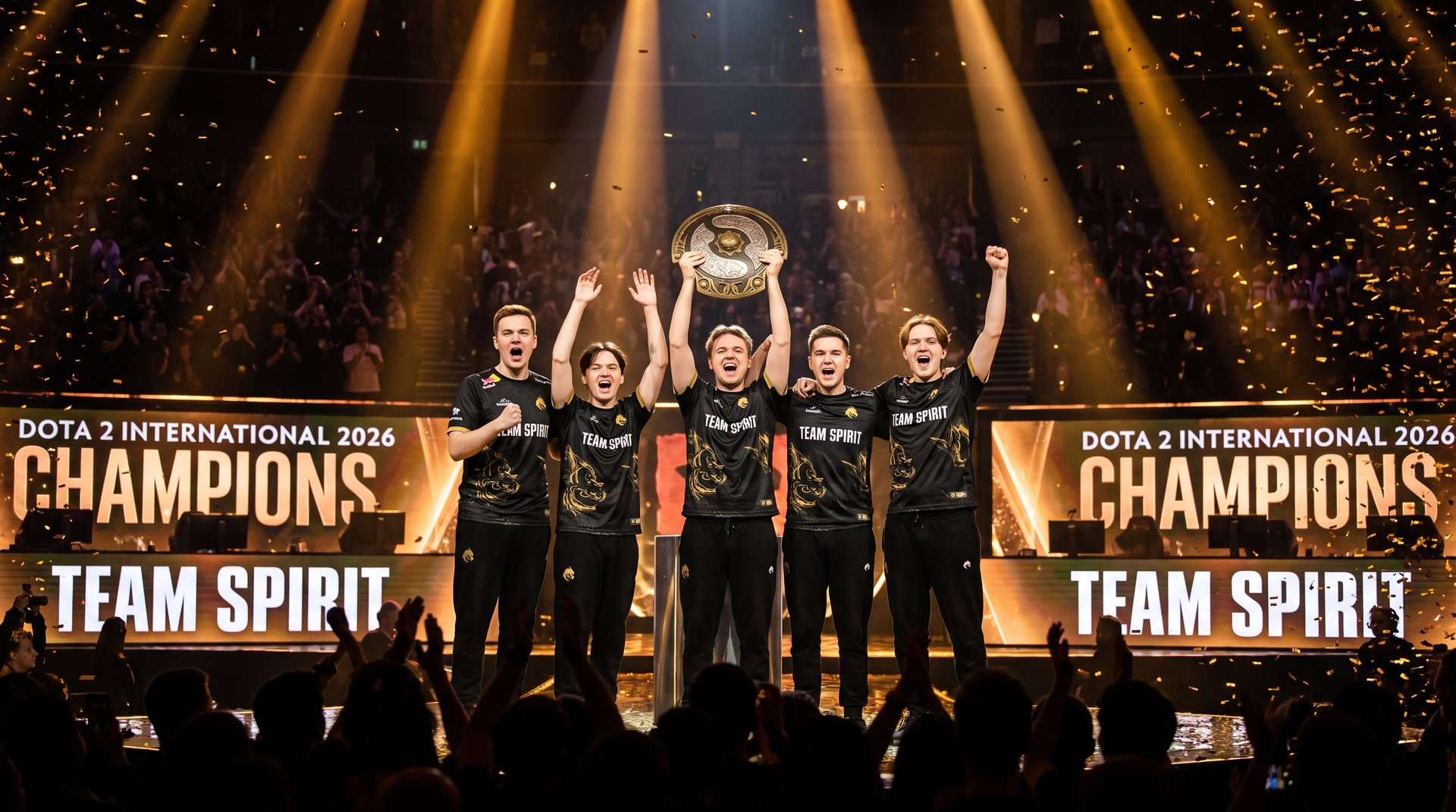
The International 2026 is now history. Team Spirit claimed their third world championship at the Oriental Sports Center in Shanghai on August 23, 2026, defeating TEAM VISION 3-2 in a five-game grand final that ended with a 64-minute decider. Behind those headlines are the numbers that define the tournament — the structural data, the prize figures, the bracket records, and the milestone achievements that put TI 2026 in its historical context.
This post breaks down every major stat and record from TI 2026 that Dota 2 players will want to reference: the prize pool split, Spirit’s bracket efficiency, the grand final series numbers, TEAM VISION’s group stage dominance, and the individual records set by players across the event. Where specific per-game stats require a database lookup (hero GPM rankings, exact kill counts by game), we link to Liquipedia and Dotabuff so you can go deeper on the numbers that matter most to you.
All tournament-level results cited here are from confirmed August 23, 2026 reporting on the final bracket outcomes.
Contents
Tournament Overview by the Numbers
Before getting into individual stats, here is the structural read on TI 2026 as a tournament — the format, the field, and the timeline that produced the final results.
| Stat | Value | Notes |
|---|---|---|
| Tournament edition | The International 2026 | 15th edition of TI (first held 2011) |
| Venue | Oriental Sports Center, Shanghai, China | China hosting TI for the third time |
| Start date | August 13, 2026 | Group Stage Day 1 |
| End date | August 23, 2026 | Grand Final completed |
| Total duration | 11 days | Group Stage + Elimination + Main Event |
| Teams invited | 16 | Across all regional qualifiers and direct invites |
| Group Stage format | Modified Swiss (Aug 13-16) | 5 rounds, top 8 advance to Main Event |
| Main Event format | Double elimination bracket | Best-of-3 until Grand Final (best-of-5) |
| Grand Final format | Best-of-5 | Went the full distance: 3-2 |
| Champion | Team Spirit | Third TI championship (2021, 2023, 2026) |
| Runner-up | TEAM VISION | Formerly PARIVISION; Grand Final 2-3 |
The modified Swiss group stage is worth explaining for players unfamiliar with it. Unlike a standard round-robin where every team plays every other team, Swiss pairs teams by current record each round. A team that starts 3-0 in the first three rounds will face another 3-0 team in Round 4 rather than a 0-3 team. This produces more competitive games in the late rounds and a cleaner tiebreaker structure for the advancement spots. TI has used variations of Swiss for group stage play across multiple editions.
Eight of the 16 teams advanced from the group stage to the Main Event double-elimination bracket. The eight teams that exited in the group stage received the bottom prize splits.
Prize Pool and Money Stats
TI prize pools are the largest in Dota 2 — and among the largest in all of esports. TI 2026 maintained that tradition.
| Placement | Team | Prize |
|---|---|---|
| 1st | Team Spirit | US$1,400,000 |
| 2nd | TEAM VISION | Split of remaining pool |
| 3rd-4th | Top 4 finishers | Split of remaining pool |
| 5th-8th | Main Event exits | Split of remaining pool |
| Total Pool | All 16 teams | US$3,330,000 |
The US$3.33M total prize pool is the confirmed figure. TI prize pools have historically been supplemented by the Battle Pass crowdfunding model, where a portion of Battle Pass sales flow into the prize pool above the base amount. The distribution model across placements follows the standard TI structure with heavier weighting toward the top 4 finishers.
For context: the first TI in 2011 had a prize pool of approximately US$1.6M — itself a record at the time for esports. TI prize pools grew significantly through the crowdfunding years, peaking at over US$40M at TI10 in 2021 (the edition Spirit first won). TI 2026’s US$3.33M reflects Valve’s current approach to prize pool structuring in the post-Battle Pass era.
Team Spirit’s US$1.4M payout is their share as TI 2026 champions. Split across five players and a coach, it represents a significant per-person payout at the top of the Dota 2 competitive earning curve — and it is the third time the Spirit organization has taken the top spot at TI.
Grand Final Series: 5 Games by the Numbers
The TI 2026 grand final between Team Spirit and TEAM VISION went to five games — the maximum possible in a best-of-five. The series required the full distance, with neither team able to close out the championship before Game 5.
| Game | Winner | Character | Running Score |
|---|---|---|---|
| Game 1 | Team Spirit | Spirit dominant; controlled early and never ceded it | Spirit 1-0 |
| Game 2 | TEAM VISION | VISION comeback — flipped a Spirit mid-game lead | Tied 1-1 |
| Game 3 | Team Spirit | Close affair; Spirit took it at the edge | Spirit 2-1 |
| Game 4 | TEAM VISION | VISION routed Spirit; forced the deciding map | Tied 2-2 |
| Game 5 | Team Spirit | 64-minute thriller; Spirit recovered from deficit to win | Spirit 3-2 — CHAMPIONS |
The 64-Minute Game 5
Game 5 of the TI 2026 grand final lasted 64 minutes. That is a significant data point on its own. Late-game grand finals at TI tend to be high-stakes precisely because both teams are playing elimination Dota — every decision carries maximum consequence, and neither team is willing to force a fight unless the odds are clearly in their favor.
A 64-minute game 5 means both teams survived to the ultra-late game. Roshan spawned multiple times. Ancient fortification timings became central. Net worth graphs almost certainly crossed multiple times. Spirit won from behind in that game — meaning at some point in a 64-minute deciding map at TI, they were losing and reversed it.
For scale: many TI grand final games in competitive history end between 35 and 55 minutes. A 64-minute game 5 puts this specific map among the longer deciding games at the tournament level. The full game duration stats for all five games in the series can be verified on Dotabuff’s TI 2026 match pages once the data is indexed.
The Pattern of the Series
The alternating win pattern (Spirit, VISION, Spirit, VISION, Spirit) is one of the statistically interesting features of this grand final. Neither team won consecutive games until Spirit’s Game 5 close. Both teams demonstrated the ability to reset after a loss and execute different approaches in the next game. Puppey’s halftime adjustments are well-documented — the VISION captain has one of the deepest TI coaching records of any player in the game’s history. The fact that VISION was able to level the series twice (1-0 became 1-1; 2-1 became 2-2) reflects genuine adaptability.
Spirit’s ability to close Game 3 on championship point and then lose Game 4 before winning Game 5 is also a data point on how series pressure plays out at the highest level. Taking a 2-1 lead is meaningful but not decisive. The team that wins Game 4 when facing elimination is the team that forces the deciding map — and VISION did exactly that before Spirit ultimately closed the series.
Spirit’s Bracket Run: The Full Record
Team Spirit’s path to their third TI championship was the most complex bracket run of any team at TI 2026. After a stumble in the group stage, they entered the Main Event through the Elimination Stage and then worked through the lower bracket to reach the grand final.
| Stage | Opponent | Result | Series Type |
|---|---|---|---|
| Elimination Stage | Team Resilience | 2-1 Win | Best-of-3 (Elimination) |
| Upper Bracket QF | Iron Wing (1w Team) | 2-0 Win | Best-of-3 |
| Upper Bracket SF | TEAM VISION | 1-2 Loss | Best-of-3 |
| Lower Bracket QF | Team Liquid | 2-0 Win | Best-of-3 (Elimination) |
| Lower Bracket SF | BoomBoys (BetBoom) | 2-0 Win | Best-of-3 (Elimination) |
| Lower Bracket Final | Team Yandex | 2-0 Win | Best-of-3 (Elimination) |
| Grand Final | TEAM VISION | 3-2 Win | Best-of-5 |
Series Record: 6-1 (Grand Final path only)
Spirit’s bracket record from the Elimination Stage onward: 6 series wins, 1 loss (to TEAM VISION in the Upper Bracket Semifinal). They played 7 total series — the most of any team in the event — and dropped only one. The single loss to VISION in the UB SF sent them to the lower bracket and forced the longer route; they responded by winning every subsequent series, including the grand final rematch against the same team that had beaten them.
Map Record in the Bracket
Counting individual games across all bracket series: Spirit went through the Elimination Stage (won 2-1 = 3 maps), UB QF (won 2-0 = 2 maps), UB SF (lost 1-2 = 3 maps), LB QF (won 2-0 = 2 maps), LB SF (won 2-0 = 2 maps), LB Final (won 2-0 = 2 maps), Grand Final (won 3-2 = 5 maps). Total maps played in the Main Event bracket: 19. Maps won: 14. Maps lost: 5. Map win rate across their bracket run: approximately 73.7%.
The Lower Bracket Streak
Spirit’s lower bracket run from the LB QF to the Grand Final: three consecutive best-of-3 wins without dropping a single map (2-0 vs Liquid, 2-0 vs BoomBoys, 2-0 vs Yandex). Then they won the best-of-5 grand final 3-2. A team that won 4 straight LB series after being dropped from the upper bracket is playing with a different kind of momentum. Lower bracket teams at TI often describe feeling that each win is a bonus — the pressure of sudden death flips into a form of freedom. Spirit has historically performed better under that kind of pressure.
TEAM VISION’s Group Stage Dominance
While Spirit’s story is the lower bracket comeback, TEAM VISION’s story at TI 2026 starts with the best group stage record of any team in the event.
| Round | VISION’s Opponent | Result |
|---|---|---|
| Group Stage Round 1 | Team Resilience | 2-0 Win |
| Group Stage Round 2 | Team Falcons | 2-0 Win |
| Group Stage Round 3 | BoomBoys (BetBoom) | 2-0 Win |
| Group Stage Round 4 | Team Spirit | 2-0 Win |
| Group Stage Round 5 | Additional match | Win |
TEAM VISION went undefeated across all five rounds of the group stage — the only team in TI 2026 to achieve a perfect group stage record. That included a 2-0 win over Team Spirit in Round 4, the eventual champions. The clean sweep of the group stage earned VISION direct entry into the Main Event (no Elimination Stage required) and placed them as the statistical favorites heading into the bracket.
The irony of TI 2026 is that the team with the best group stage record finished second, and the team that stumbled through the group stage (Spirit dropped games in Round 4 and Round 5, requiring them to go through the Elimination Stage) won the championship. This pattern has historical precedent at TI: dominant group stage performance does not guarantee championship performance in the elimination bracket. The psychological dynamics of double-elimination, combined with the additional rest versus momentum trade-off between the two finalists, regularly produces upsets relative to group stage seeding.
Player Records and Career Milestones
TI 2026 produced several individual records that stand independently of the team result.
Team Spirit’s Three-Time Champions
| Player | Role | TI Titles | Years Won |
|---|---|---|---|
| Yatoro | Carry (Position 1) | 3 | 2021, 2023, 2026 |
| Collapse | Offlaner (Position 3) | 3 | 2021, 2023, 2026 |
| Miposhka | Coach | 3 | 2021, 2023, 2026 |
| Larl | Mid (Position 2) | 2 | 2023, 2026 |
| not me | Support (Position 4) | 1 | 2026 |
| rue | Support (Position 5) | 1 | 2026 |
Yatoro, Collapse, and Miposhka are now three-time TI champions. In the entire history of the competition, no player had previously won The International three times. OG players Johan “N0tail” Sundstein and Topias “Topson” Taavitsainen won back-to-back TIs in 2018 and 2019 — a two-title record that stood as the individual championship benchmark until Spirit’s 2023 victory brought Yatoro and Collapse to two titles, and 2026 brought them to three.
The three-title milestone is not just a number — it reflects sustained performance across a sport where the competitive environment changes significantly between editions. Rosters shift, the meta evolves, patches change the fundamental game, and new talent enters the competitive scene every year. Winning TI once is extremely difficult. Winning it three times, including twice with the same core three players, is an achievement that may not be replicated.
Larl’s two consecutive TI titles (2023 and 2026) are worth their own note. Back-to-back TI championships as the mid laner is a performance record that places him in the top tier of Dota 2 competitive history, independent of what future editions bring.
Puppey’s Attendance Record
TEAM VISION captain Clement “Puppey” Ivanov set a unique record at TI 2026: he is now the only player to have attended every edition of The International from TI 2011 through TI 2026 — a 15-year consecutive run at the world championship.
| Stat | Puppey at TI 2026 |
|---|---|
| Consecutive TI appearances | All editions from TI1 (2011) through TI 2026 |
| TI1 result | Champion (Natus Vincere) |
| Notable runner-up finishes | TI2 (2012), TI3 (2013), TI12 (2022), TI 2026 |
| Career TI championships | 1 (TI1, 2011) |
| Career TI grand finals | 5+ (including 2026) |
Puppey’s record of reaching the TI 2026 grand final — and taking Team Spirit to five games at age 35+ after more than 15 years of competing at the highest level — is one of the individual statistical stories of the event. His TI1 championship with Natus Vincere in 2011 means he holds both the longest current streak of TI appearances and a championship from the first ever edition of the tournament. No other active player spans the full history of TI the way Puppey does.
Where TI 2026 Stands in TI History
Numbers acquire meaning through context. Here is how TI 2026 fits into the broader statistical history of the competition.
| Record | TI 2026 Result | Historical Context |
|---|---|---|
| Most TI titles (team) | Team Spirit: 3 (2021, 2023, 2026) | Previous record: OG 2 (2018, 2019) |
| Most TI titles (player) | Yatoro, Collapse: 3 each | New record — previous best was 2 |
| First player at every TI | Puppey (TI1 2011 through TI 2026) | Unique; no other player matches this |
| Grand final games played | 5 (maximum BO5) | Both teams took the series to the limit |
| Longest grand final game | 64 minutes (Game 5) | Among the longer TI grand final deciders |
| Team prize (1st) | US$1,400,000 | From US$3.33M total pool |
| Champion from lower bracket | Yes (Spirit went through LB) | Spirit also won TI10 from LB (2021) |
The “three-time champion” record deserves expansion. In roughly 15 editions of TI (2011 through 2026, accounting for the pandemic gap), only three organizations had previously won the tournament more than once: Natus Vincere (TI1), OG (TI8 and TI9), and Team Spirit (TI10 and TI12). Spirit are now the only three-time winners. OG’s back-to-back record in 2018-2019 is still the only consecutive championship achievement — Spirit’s wins are spread across five years, which is arguably harder to sustain given how much the competitive landscape changes.
Spirit’s second lower bracket championship (first in 2021 at TI10) is also a notable structural record. Coming through the lower bracket at TI requires winning more series than upper bracket teams, under elimination pressure every step of the way. Doing it twice — at TI10 and again at TI 2026 — suggests it is not a fluke of tournament structure but a reflection of how this team actually performs under maximum pressure.
What These Numbers Mean for Ranked Players
The stats and records of TI 2026 are interesting on their own, but for players trying to climb MMR, they also contain transferable lessons. Here is what the data says that applies below the professional level.
The Group Stage Peak Does Not Predict the Bracket Outcome
TEAM VISION’s 5-0 group stage record made them statistical favorites to win TI 2026. They finished second. Team Spirit stumbled in the group stage and won the tournament. This pattern repeats across TI history because double-elimination brackets reset advantages: a loss sends you to the lower bracket rather than eliminating you, and the experience of winning under elimination pressure compounds over a bracket run.
In ranked Dota, this translates to not treating any individual losing streak as evidence of your true skill level. A bad patch of games is a group stage stumble, not a definitive result. What matters is what you build from it and whether you perform when it counts — in the games where one more loss means significant MMR loss. The mental framework for performing under pressure is separable from raw game knowledge and responds to deliberate practice.
Consistency Across Five Games, Not Just One
The fact that neither team won the TI 2026 grand final in three or four games — that it required the full five — means both Spirit and TEAM VISION demonstrated the ability to reset and compete even after significant losses in the series. VISION leveled the series twice. Spirit closed it twice.
In ranked play, the equivalent skill is the ability to maintain decision quality in a session after a loss rather than tilting into compounding errors. If you check the data on MMR climbing patterns, the players who gain the most MMR in a month are rarely the ones with the best individual game performance — they are the ones who maintain the highest number of quality decisions across the largest number of games, including the games immediately after a loss.
Farming Efficiency as the Core Carry Metric
Yatoro’s carry performance throughout TI 2026 — referenced across the bracket as a key factor in Spirit’s wins — consistently came back to farming efficiency. The ability to hit item power spikes faster than opposing carries can respond is the core mechanic that makes carries decisive in professional Dota. That mechanic is more accessible in ranked play than most players think.
If you want to improve as a position 1, the single most impactful improvement is last hit discipline under lane pressure followed by jungle efficiency routing. The MMR climbing guide covers this in detail, but the short version from TI 2026: the carry whose items come online first has an advantage that compounds through teamfight math for the next 20 minutes. Protecting and accelerating that window is the most transferable lesson from watching Yatoro play.
The Value of a Diverse Draft Pool
Both Spirit and TEAM VISION showed multiple viable strategies across the five games of the grand final. Neither team ran the same approach twice in a row. Spirit’s Game 1 and Game 3 wins came through different hero configurations, as did VISION’s Game 2 and Game 4 wins. The ability to shift between strategies mid-series — and draft responsively rather than with a predetermined plan — is what makes teams dangerous in a best-of-5.
For ranked players, this is the argument for having a hero pool of 3-5 heroes per role rather than one signature pick. A single hero you can play at 100% of your ceiling beats a 5-hero pool you play at 80% — but the 5-hero pool beats the one-trick when the meta shifts, when the enemy bans your hero, or when your team’s draft needs you to fill a specific function. The boosting safety guide also covers how playing different heroes affects account pattern detection, which is a practical secondary reason to develop range.
Use TI 2026’s Lessons to Climb Your Own Bracket
Spirit came from behind to win. The principles they used — farming efficiency, draft flexibility, composure under pressure — are teachable skills. If you want to accelerate the climb, TeamSmurf’s boosters are the same caliber of players you just watched at TI. Let them show you what the game looks like from Immortal.


