Dota 2 MMR Table 2026: Exact MMR for Every Medal and Star

Every rank in Dota 2 has an exact MMR number behind it — but Valve does not print those numbers on screen. What you see is a medal and a star count. What actually determines your medal is a hard numerical threshold, and this page has the complete breakdown for 2026.
Below you will find the exact MMR floor and ceiling for every medal from Herald 1 through Divine 5, how each star is calculated, and what Immortal actually means for regional leaderboard placement. Whether you are planning a climb, checking how far you are from the next medal, or deciding whether a Dota 2 boosting service makes sense for your situation, this table gives you the numbers you need.
Table of Contents
- The Complete Dota 2 MMR Table 2026
- How Stars Are Calculated Within Each Medal
- Herald and Guardian: 0 — 1539 MMR
- Crusader and Archon: 1540 — 3079 MMR
- Legend and Ancient: 3080 — 4619 MMR
- Divine: 4620 — 5419 MMR
- Immortal: 5420+ MMR and Leaderboard Cutoffs
- Why Your Displayed Rank May Lag Behind Your MMR
- How to Use This Table to Plan Your Next Medal
- Frequently Asked Questions
The Complete Dota 2 MMR Table 2026
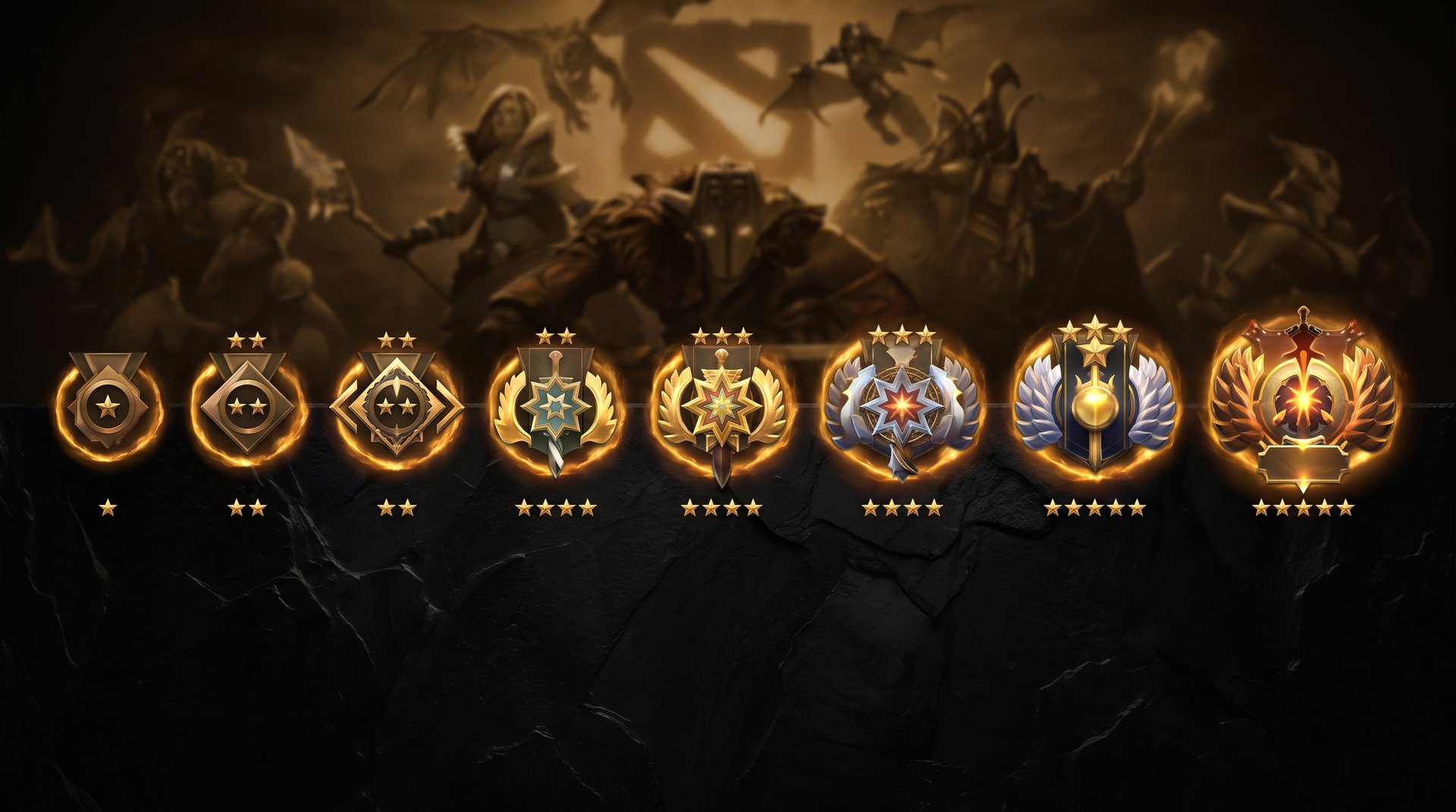
This table uses community-verified thresholds consistent with how Valve’s matchmaking system has worked since the current seasonal ranking format launched. Each full medal covers a 770-MMR range (Herald through Ancient), divided into 5 stars of 154 MMR each. Divine covers 800 MMR, so each Divine star is 160 MMR. Immortal has no star cap — placement is by leaderboard rank within your region.
| Medal | MMR Range | Star 1 | Star 2 | Star 3 | Star 4 | Star 5 | MMR per Star |
|---|---|---|---|---|---|---|---|
| Herald | 0 — 769 | 0 — 153 | 154 — 307 | 308 — 461 | 462 — 615 | 616 — 769 | 154 |
| Guardian | 770 — 1539 | 770 — 923 | 924 — 1077 | 1078 — 1231 | 1232 — 1385 | 1386 — 1539 | 154 |
| Crusader | 1540 — 2309 | 1540 — 1693 | 1694 — 1847 | 1848 — 2001 | 2002 — 2155 | 2156 — 2309 | 154 |
| Archon | 2310 — 3079 | 2310 — 2463 | 2464 — 2617 | 2618 — 2771 | 2772 — 2925 | 2926 — 3079 | 154 |
| Legend | 3080 — 3849 | 3080 — 3233 | 3234 — 3387 | 3388 — 3541 | 3542 — 3695 | 3696 — 3849 | 154 |
| Ancient | 3850 — 4619 | 3850 — 4003 | 4004 — 4157 | 4158 — 4311 | 4312 — 4465 | 4466 — 4619 | 154 |
| Divine | 4620 — 5419 | 4620 — 4779 | 4780 — 4939 | 4940 — 5099 | 5100 — 5259 | 5260 — 5419 | 160 |
| Immortal | 5420+ | No stars — ranked by leaderboard position within region | — | ||||
How Stars Are Calculated Within Each Medal
Valve’s system does not display your raw MMR number in most views — it translates that number into a medal and a star count. Understanding the math behind that translation lets you track your progress precisely rather than waiting for the game to tell you when you have upgraded.
The 154-MMR Star Rule (Herald Through Ancient)
For the six medals from Herald through Ancient, each medal spans exactly 770 MMR. Divide that by five stars and each star covers 154 MMR. The star you display is determined by which band your current MMR falls into:
- Star 1 — Medal floor to floor + 153 MMR
- Star 2 — Floor + 154 to floor + 307 MMR
- Star 3 — Floor + 308 to floor + 461 MMR
- Star 4 — Floor + 462 to floor + 615 MMR
- Star 5 — Floor + 616 to floor + 769 MMR (or the ceiling of that medal)
So if you are sitting at 2,550 MMR, you are in the Archon bracket (floor 2,310). Your offset is 240 MMR. Divide by 154 and round up — that puts you at Archon 2. You need 2,618 to reach Archon 3, which is 68 more MMR from 2,550.
Divine Is Different: 160 MMR per Star
Divine spans 800 MMR (4620 to 5419) instead of 770, making each of its five stars 160 MMR wide instead of 154. The same calculation method applies, but use 160 as your divisor. A player at 5,050 MMR has an offset of 430 from the Divine floor (4,620). Divide by 160: 2.69, round up to 3. They are Divine 3, needing 5,100 for Divine 4 — 50 MMR away.
Immortal Has No Stars
Once you cross 5,420 MMR you enter the Immortal bracket. The game stops tracking progress by stars and instead shows your leaderboard rank within your server region (EEU, SEA, NA, SA, Australia, and others). The leaderboard top 5,000 per region are shown publicly. Below that cutoff your Immortal badge still shows, but without a leaderboard number.
Herald and Guardian: 0 — 1539 MMR
Herald (0-769 MMR) is the entry-level bracket. New accounts that calibrate at the floor of the system land here, and so do experienced players returning after long breaks who have lost their calibration baseline. Games at Herald are characterized by fundamental mechanical gaps: missed last-hits, items bought in the wrong order, lanes left unattended. This is not a criticism of Herald players — every Dota 2 career starts somewhere — but it explains why MMR movement here can be volatile. A player who has spent time in a coaching program or studying fundamentals can gain significant MMR per session in this bracket.
Guardian (770-1539 MMR) introduces more consistent fundamentals but strategic decision-making is still limited. Players start to buy dedicated support items and contest objectives, but coordination remains rare. At around 1,200-1,300 MMR many players first encounter the “improvement wall” where individual skill matters more than it did at Herald but solo-carrying is harder than it will later become. The MMR boosting guide on TeamSmurf goes into detail on the mechanics that matter most at each bracket for climbing under your own steam.
| Medal | MMR Floor | MMR Ceiling | Skill Level Context | Approx. % of Ranked Players |
|---|---|---|---|---|
| Herald | 0 | 769 | Early learning, fundamental gaps | ~10-15% |
| Guardian | 770 | 1539 | Basics forming, lanes contested | ~15-20% |
| Crusader | 1540 | 2309 | Role awareness emerging | ~20-25% |
| Archon | 2310 | 3079 | Most common bracket, core mechanics solid | ~20-25% |
The percentages above are approximate community-aggregated estimates from sites like OpenDota and STRATZ and vary by region and season. They give a sense of how many players you are competing with at each bracket but should not be taken as official Valve figures.
Crusader and Archon: 1540 — 3079 MMR
Crusader (1540-2309 MMR) is where role identities start to solidify. Supports buy wards more consistently. Carries buy farming items rather than fighting items prematurely. Players start to respond to enemy movements rather than ignoring the minimap entirely. The gap between Crusader 1 (1540 MMR) and Crusader 5 (2309 MMR) is significant: a Crusader 5 player would likely outperform a Crusader 1 player in most game situations, and the difference compounds in teamfights where coordination matters.
Archon (2310-3079 MMR) is the bracket where the largest concentration of Dota 2 players sits globally. The majority of the playerbase in most regions falls somewhere between Archon 1 and Legend 2. This makes Archon an important benchmark: beating this bracket requires more than mechanical competence, it requires game-sense about objective timing, draft awareness, and the ability to influence multiple lanes across a game. Players stuck in Archon for extended periods often benefit most from Dota 2 coaching targeting specific strategic blind spots rather than mechanical improvement alone.
The Archon-Legend Transition: The Real Climb Inflection Point
The jump from Archon 5 (3,079 MMR) to Legend 1 (3,080 MMR) is numerically tiny — one win of net MMR — but it represents a meaningful skill filter. Legend games feature significantly more proactive rotations, earlier tower contests, and players who have developed actual hero pools rather than playing whatever role is available. If you find yourself consistently reaching Archon 5 but regressing back to Archon 4 or lower, that is the most common form of the MMR plateau in competitive Dota 2.
The structural difference between Archon 5 and Legend 1 games is real but the MMR required to cross is small. This means your win rate at Archon 5 is the only number that matters — a player consistently winning 55% of games will cross into Legend within a predictable number of games, regardless of how long they have been stuck at Archon 5.
Legend and Ancient: 3080 — 4619 MMR
Legend (3080-3849 MMR) players understand the draft, can execute multi-hero combos, and have typically logged a significant number of hours in the game. Lane equilibrium management, smoke rotations, and Roshan timing are concepts that start to be applied deliberately here rather than accidentally. The skill floor at Legend 1 is meaningfully higher than at Archon 5, even though the MMR gap is one point.
Ancient (3850-4619 MMR) is roughly the top 5-10% of the playerbase, depending on region and season. Games at Ancient look structurally different from Archon: supports make buyback decisions, cores think about item timings relative to the enemy lineup rather than just their own progression, and the draft matters significantly. A mismatched draft against an Ancient-level team is punishing in a way it would not be in Archon. The safety and legality of boosting is a common question at this bracket, where players are often close to a personal milestone and want to know their options.
Ancient 5 (4619 MMR): The Gateway to Divine
Ancient 5 is often considered one of the most meaningful milestones in non-professional Dota 2. Reaching 4,620 MMR to enter Divine 1 means you have crossed into the top 1-2% of players in most regions. The final push from Ancient 4 (4,312 MMR) to that threshold — 308 MMR — represents some of the most contested games on the server. Every player in the lobby at Ancient 5 is trying to cross the same line, which makes these games particularly volatile and high-pressure.
One tactical note for players pushing through Ancient: hero pool breadth matters more at this bracket than any point below it. You will face opponents who actively try to counter-pick your known hero. Having at least two strong heroes per role allows you to draft around counter-picks rather than being forced onto a suboptimal pick repeatedly.
Divine: 4620 — 5419 MMR
Divine is the penultimate bracket and the last one with a star system. All five Divine stars are 160 MMR wide, slightly wider than the 154-MMR stars below. Divine players are in the top 1-2% globally. Games are structured, communication is visible through coordinated map movements even without voice chat, and individual hero mastery is generally high. Most players who reach Divine have a strong two-to-three hero pool and understand the matchup implications of their picks.
| Divine Star | MMR Floor | MMR Ceiling | Typical Context |
|---|---|---|---|
| Divine 1 | 4620 | 4779 | Entry point, adapting to Divine tempo |
| Divine 2 | 4780 | 4939 | More consistent macro decisions |
| Divine 3 | 4940 | 5099 | High individual hero mastery expected |
| Divine 4 | 5100 | 5259 | Near-Immortal skill floor, mixed lobbies |
| Divine 5 | 5260 | 5419 | Regularly queuing with Immortal players |
At Divine 4 and 5 (5100-5419 MMR), players are regularly matched with Immortal players. The difference between Divine 5 and the Immortal threshold is 161 MMR — roughly two net wins. But those two wins at that rating are against players who in many cases have thousands more hours in the game than the average Divine 5 opponent.
The Divine bracket also introduces a change in how team communication functions. Below Divine, most coordination happens through ping signals and general hero movement. At Divine 4 and above, players are more likely to be actively communicating strategy and adapting drafts with genuine understanding of what each pick creates in terms of game plan. This makes solo-queue play at Divine harder than at Ancient, not because of individual skill gaps, but because of coordination expectations.
Immortal: 5420+ MMR and Regional Leaderboard Cutoffs
Crossing 5,420 MMR moves you from the star-based system into the Immortal bracket. At this point your rank display shifts from a star count to a leaderboard number within your region. Valve maintains regional leaderboards covering the top 5,000 players per region. Below the top 5,000 cutoff your Immortal badge still shows, but without a numbered position.
Regional Leaderboard MMR Estimates (2026)
Leaderboard cutoffs fluctuate with the player population in each region and the point in the season. The figures below are approximate ranges observed across recent ranked seasons, based on community tracking from OpenDota and STRATZ. They are not official Valve figures — treat them as directional benchmarks, not guaranteed thresholds.
| Region | Immortal Entry (approx.) | Approx. MMR: Top 5,000 | Approx. MMR: Top 1,000 | Approx. MMR: Top 100 |
|---|---|---|---|---|
| EEU (Eastern Europe) | 5420+ | 5,800 — 6,200 | 7,200 — 8,000 | 9,000+ |
| SEA (Southeast Asia) | 5420+ | 5,600 — 6,000 | 6,800 — 7,500 | 8,500+ |
| NA (North America) | 5420+ | 5,500 — 5,900 | 6,500 — 7,200 | 8,000+ |
| SA (South America) | 5420+ | 5,450 — 5,800 | 6,200 — 6,800 | 7,500+ |
| AUS (Australia/OCE) | 5420+ | 5,420 — 5,700 | 5,900 — 6,500 | 7,000+ |
EEU consistently has the highest leaderboard floor because it has the largest high-MMR player pool. SEA is second, with a deep talent base connected to the competitive scene. NA and SA have smaller populations at the top end, so the MMR required to enter leaderboard positions is slightly lower. AUS has the most compressed leaderboard range due to smaller overall player counts in the high-MMR tier.
Immortal Rank Points: What They Measure
At Immortal, your leaderboard position is not purely determined by raw MMR. Valve has used Immortal Rank Points (IRP) as a secondary system where playing more games at Immortal affects placement. This has varied across seasons — in some patches IRP and MMR are essentially the same ranking signal, in others the volume of play at Immortal adds ranking weight. Check the current patch notes or the official Dota 2 matchmaking blog for how IRP is weighted in the active season.
Why Your Displayed Rank May Lag Behind Your MMR
Players sometimes notice that their profile or the post-game screen shows a different star count than what they expect given their known MMR. There are a few reasons for this discrepancy that are worth understanding:
- Season timing: Medal updates do not apply instantly mid-session. If you cross a star threshold mid-game, the updated badge appears only when you return to the main menu after the match completes.
- Recalibration windows: At the start of a new season, ranks are recalibrated based on your previous MMR. During the calibration window (typically 10 games), your displayed rank may be provisional and lower than your current MMR implies.
- Third-party tracking lag: Sites like STRATZ and Dotabuff use different update windows than the game client. Checking immediately after a game ends may show a rank that does not yet reflect your last result.
- Server-side processing: In some rare cases, the MMR change processes on the backend before the rank recalculation completes. A client restart typically resolves this.
None of these represent a bug in the system. They are normal features of how the rank display updates asynchronously from the underlying MMR change event.
How to Use This Table to Plan Your Next Medal
The most practical use of this reference is MMR gap math — knowing exactly how many net wins separate you from your next milestone. Here is how to apply it in practice.
Calculate Your Gap in Wins
Take your current MMR and subtract it from the floor of the next star up. That gap divided by the average net MMR gain per win gives you an estimated net win count. At most brackets, a win on a matched game gives +25 to +30 MMR and a loss costs -25 to -30. A 154-MMR star gap requires roughly 5-6 net wins to cross — winning more than you lose, not 5-6 individual wins.
| Current MMR | Medal | Next Star Floor | Gap | Approx. Net Wins Needed |
|---|---|---|---|---|
| 2,400 | Archon 2 | 2,464 | 64 MMR | 2-3 net wins |
| 3,000 | Archon 5 | 3,080 (Legend 1) | 80 MMR | 3 net wins |
| 3,750 | Legend 5 | 3,850 (Ancient 1) | 100 MMR | 4 net wins |
| 4,550 | Ancient 5 | 4,620 (Divine 1) | 70 MMR | 3 net wins |
| 5,200 | Divine 4 | 5,260 (Divine 5) | 60 MMR | 2-3 net wins |
| 5,350 | Divine 5 | 5,420 (Immortal) | 70 MMR | 3 net wins |
The Hero Pool Rule by Bracket
The table above gives you the destination. What gets you there is hero selection strategy, and it changes by bracket. At Herald and Guardian (below 1,540 MMR), broad hero knowledge matters less than picking simple, forgiving heroes and executing lane fundamentals correctly. At Archon and Legend, a two-hero pool per role outperforms one-tricking because it allows reactive counter-picks. At Ancient and above, your hero pool is expected to be deep enough that opponents actively try to counter-draft you — and you need answers prepared.
Negative Winstreak Mechanics: When to Reassess
If you are losing more than winning over a significant sample (50+ ranked games), the issue is almost never the matchmaking. It is a skill gap that needs diagnosing, not a luck problem that needs endurance. Common culprits at each bracket:
- Herald-Guardian: Last-hitting below 35 CS at 10 minutes in your role, dying more than 5 times per game on average.
- Crusader-Archon: Not contesting or securing Roshan in games where your team has the advantage, or buying inefficient items for the matchup.
- Legend-Ancient: Playing the same game plan regardless of draft, missing rotation windows, not adapting item builds to the enemy lineup.
- Divine: Communication and coordination failures, hero pool too narrow to handle counter-draft pressure.
For players who have diagnosed the problem and want to skip the climb on a specific bracket while they develop skills in a higher-MMR environment, TeamSmurf’s boosting service provides a clean path forward. Boosters play on your account as Immortal-ranked players targeting your role and hero pool, accumulating net wins efficiently rather than letting variance drive results. The safety guide explains exactly how account protection works throughout an order.
Skip the Grind — Get to Your Target MMR Faster
You now know the exact MMR you need for every medal and star. TeamSmurf Immortal-ranked boosters can close that gap whether you are three stars or three medals away. VPN, offline mode, and solo queue options are included as standard on every order.
Get Your MMR Boost Compare Boosting Services