Liquid vs Falcons TI 2026: Why Falcons Are Out

Team Liquid knocked Team Falcons out of TI 2026 by doing three simple things better than them: they drafted for cleaner lanes after game one, they punished Falcons’ greedy tri-core rhythm, and they never gave away the one kind of fight Falcons needed to flip the map back.
This series mattered because it was not some random lower-bracket clash. It was the last two TI champions meeting in an elimination match on 21 August. Liquid won 2-1. Falcons went home in 7th-8th. Cr1t then said this was probably his last TI. That turns a normal recap into something bigger: a title defense ending, a roster era maybe ending with it, and a full case study in how a world-class team can still lose when the draft stops giving it easy entries.
If you watched only the scoreline, you missed the real lesson. Falcons were still explosive enough to crush game one by 43-18 kills and an absurd 89,000 gold lead, but Liquid solved the series once they stopped playing Falcons’ tempo. That is the part ranked players should steal. If your stack or solo queue team keeps feeding the enemy’s comfort timing, you do not need more mechanics first. You need a better read on what fight the other draft wants.
We will break down the whole series, the exact heroes, the timings that mattered, and what it means for your own climb. If you are working through the same kind of midgame throw patterns in ranked, our MMR boosting guide, boosting safety guide, and Dota 2 coaching service cover the practical side from there.
Table of Contents
Quick Answer: Why Are Falcons Out?
Falcons are out because Team Liquid dragged the series away from Falcons’ favorite game state. In game one, Falcons got the exact kind of open map they want: tri-core scaling, Bounty Hunter vision, Mirana mobility, and enough early control that they could cash every lane win into more map ownership. Liquid got smashed.
Then Liquid adapted. They drafted faster lane pressure in game two, hit their first real power spike on time, and never let Falcons snowball first. In game three, they went one layer deeper: they turned Centaur into a position 4 flex, last-picked Viper into Falcons’ Lifestealer opener, and built a fight pattern where Faceless Void plus two ranged cores outscaled every clean initiation Falcons could find.
That is the entire story in one line: Falcons looked unbeatable when they could choose the fight, and ordinary when Liquid forced them to walk into bad fights instead.
Series Facts You Need Before the Breakdown
| Detail | Result | Why It Matters |
|---|---|---|
| Match | Team Liquid 2-1 Team Falcons | Lower-bracket round 1 elimination match at TI 2026 |
| Date | 21 August 2026 | One day before TI’s penultimate bracket day |
| Falcons finish | 7th-8th place | The defending champions failed to defend the Aegis |
| Liquid finish after series | Top 6 locked | They stayed alive for a third Aegis push |
| Game 1 duration | 55:51 | Falcons won with a full map choke and huge net worth lead |
| Game 2 duration | 34:17 | Liquid won fast once their tempo draft hit |
| Game 3 duration | 42:13 | Liquid’s draft edge showed up in every real teamfight |
| Official match IDs | 8956943534, 8957013760, 8957086928 | Useful if you want to cross-check VODs or stat sites |
| Cr1t quote after elimination | “This is probably the last TI” | The result also became a roster-era story, not just a series recap |
The official TI site showed the match as lower-bracket round 1 and confirmed the three-game set. GosuGamers added the useful human layer: prize implications, Falcons’ 7th-8th exit, and Cr1t’s retirement hint right after the loss.
Game-by-Game Breakdown
Game 1: Falcons Got Their Dream Script
Falcons opened with one of the most Falcons-looking drafts you can build in this meta. Skiter got Sven. Malr1ne got Earthshaker. ATF got a damage-heavy offlane core. Cr1t played Bounty Hunter, which matters more than casual viewers think because that hero is not just “vision.” Bounty turns every won lane into a permanent information tax. Once the first supports start dying under Track, your smoke routes get exposed and your comeback windows shrink.
Liquid answered with a lineup that could theoretically defend high ground forever: miCKe on Lina, Nisha on Invoker, Ace on Underlord, Boxi on Spirit Breaker, and tOfu on Rubick. On paper, that kind of draft can stall until one bad dive gives it a swing fight. In practice, Falcons hit them too hard in lanes and never let the map breathe.
The numbers tell you how ugly it got. Falcons won game one in 55:51 with a 43-18 kill score. Skiter finished 16/5/10 on Sven. ATF posted 12/1/15. Sneyking ended 8/5/26. Malr1ne added seven kills and 25 assists. GosuGamers reported the final net worth gap at more than 89,000 gold, the biggest gap of any game at TI 2026 so far.
The Immortal-level read here is not “Falcons outplayed them in fights.” It is more specific. Falcons won the lanes so hard that Liquid’s first real teamfight timing never arrived on schedule. When that happens against Sven plus Track tempo, every defensive spell becomes a tax payment instead of an opening. Underlord gate, Invoker wave clear, Rubick saves, Spirit Breaker side pressure — all good tools, but all reactive. Falcons forced Liquid to defend instead of contest.
Even the way Falcons closed the game mattered. They did not panic into a random high-ground throw. They kept farming, stacked more net worth, and waited until the base crack had almost no downside. That patience is the part pub teams almost never copy.
Game 2: Liquid Fixed the Lanes and the Series Flipped
Liquid’s second draft was the actual turning point of the series. They moved away from slow defensive scaling and picked a lineup that could win the map before Falcons’ comfort cores got to dictate it. miCKe took Windranger. Nisha played Earth Spirit. Ace stayed on Underlord. Boxi got Tusk. tOfu played Hoodwink.
Falcons tried to answer with another aggressive shell: Sven for Skiter, Lina for Malr1ne, Centaur Warrunner for ATF, Enchantress for Cr1t, and Bane for Sneyking. That looks playable until you notice what Liquid did to the lanes. They gave themselves multiple heroes that can force first contact and then keep chasing after the first spell exchange. Windranger and Earth Spirit do not just survive messy fights. They turn bad Falcons jumps into dragged-out skirmishes, which is exactly what Falcons did not want after game one.
Liquid smashed that game in 34:17. The kill score was 40-11. miCKe ended 10/2/17. Nisha posted 9/3/23. Ace and tOfu both had eight kills and combined for 37 assists. That assist count matters because it tells you the game was not won by one giga-farmed carry. It was won by clean layered fighting where every Liquid hero arrived on time.
From an Immortal support perspective, the most important change was not hero names. It was who got to enter first. In game one, Falcons started everything and Liquid tried to live through it. In game two, Liquid started enough of the map movement that Falcons had to spend stuns defensively. The moment Earth Spirit and Tusk get to play first around side lanes, Falcons lose the luxury of saving cooldowns for the perfect core target.
That is why the game looked “suddenly easy.” It was not momentum magic. It was entry control.
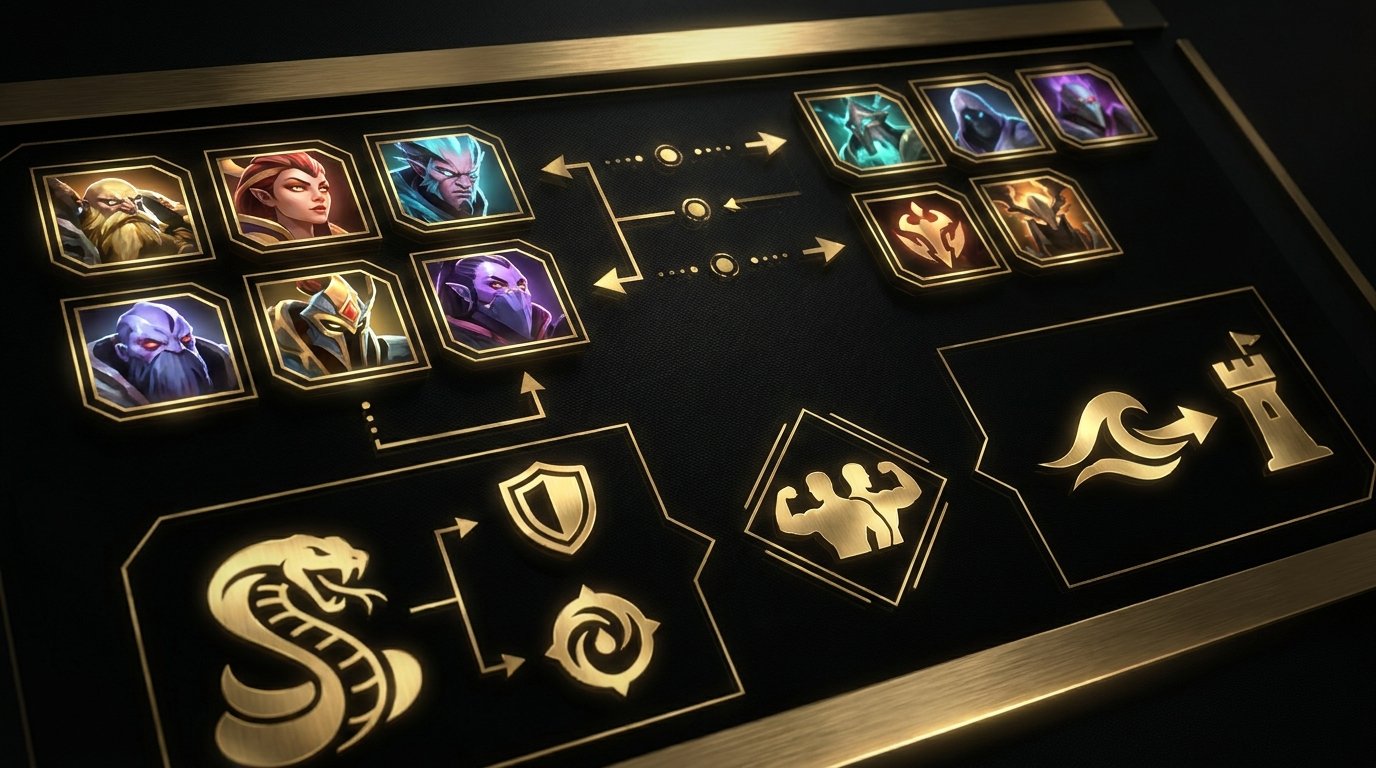
Game 3: Liquid Won the Draft and Then Played It Properly
Game three is where the series became a real lesson instead of a normal reverse sweep. Falcons first-picked Lifestealer for Skiter and built back into the familiar shape: Malr1ne on Sand King, ATF on Razor, Cr1t on Clockwerk, Sneyking on Crystal Maiden. That lineup can still kill you if it gets the usual midgame entry: Lifestealer bomb, Sand King jump, Razor controlling the front line long enough for the rest to catch up.
Liquid answered with one of the best small draft twists of TI so far. They picked Centaur early, then flexed it to support for Boxi. That let them last-pick Viper for Ace into Lifestealer. miCKe got Faceless Void. Nisha stayed on Lina. tOfu kept Hoodwink. That draft does three brutal things to Falcons:
- It ruins the carry lane. Lifestealer wants to ignore harass and stabilize into his first item timing. Viper makes the lane miserable and punishes every greedy trade.
- It forces awkward jumps. Chronosphere plus Lina plus Viper means Falcons cannot afford a half-committed front line. If Razor or Sand King goes in without perfect backup, they die before Lifestealer reaches real damage output.
- It lowers Falcons’ error margin around vision. Hoodwink and support Centaur both make it harder for Clockwerk to take free map space before fights.
Liquid then played the lanes exactly how the draft asked them to. They focused pressure on Skiter and ATF early, got the midgame into a place where Falcons’ cores were under-farmed, and never gave Lifestealer the clean infestation angle that usually rescues this kind of draft.
The game lasted 42:13. Nisha closed 10/5/17. miCKe posted 8/2/17. Ace and tOfu each had nine kills, and together they put up 38 assists. That is not random stat padding. It means the side cores and supports were doing enough damage that Falcons could not just itemize for one carry and call it solved.
This is the purest reason Falcons are out: once Liquid forced them off the easy lane phase, Falcons never found a second draft in the series that gave them a clean map again.
Why Liquid Won: The Real Strategic Differences
| Area | Liquid’s Edge | Why It Beat Falcons |
|---|---|---|
| Laning correction | They fixed their early map pressure after game one | Falcons never got another free snowball lane phase |
| Draft flexibility | Support Centaur and last-pick Viper in game three | Falcons’ Lifestealer opener lost a lot of value before the horn even sounded |
| Fight entry | Earth Spirit, Tusk, Hoodwink, and Centaur gave Liquid first move tools | Falcons had to spend their jump reactively, which breaks tri-core flow |
| Damage profile | Liquid split threat across miCKe, Nisha, and Ace | Falcons could not solve every fight by disabling one hero |
| Mental reset | They did not chase the game one loss emotionally | That matters in elimination sets more than most people admit |
Liquid also understood the difference between “Falcons are ahead” and “Falcons can end.” In game one they failed that test. In games two and three they passed it. That sounds obvious, but it is one of the main reasons high-level Dota feels so different from pub Dota. Elite teams do not defend every tower the same way. They know which objective is a bluff, which smoke is fake pressure, and which wave must be contested because the next one exposes triangle access or Roshan posture.
Liquid were especially good at avoiding the wrong early defensive fight after losing lane. That is a habit most 4K to 6K stacks still struggle with. If your draft needs one more wave on two cores, the bravest play is often refusing to fight until the wave is done.
Why Falcons Lost: Four Mistakes That Snowballed Across the Set
1. They Trusted Comfort More Than Adaptation
Falcons kept leaning back toward the same shape: tri-core damage, hard jump, strong skirmish supports, and confidence that one good lane phase would carry the whole game. That worked in game one. It stopped working once Liquid started drafting to punish the shape instead of contesting it directly.
2. Their Carry Access Got Harder Every Game
Skiter’s Sven looked excellent when Falcons could choose fights. Skiter’s Lifestealer looked much worse once Viper and Faceless Void changed the geometry of every engagement. This is a classic pub lesson too: some carries are not weak in isolation, they are weak when the enemy can decide where the fight starts.
3. They Could Not Recreate the Game One Map
Falcons are terrifying when they own both deep vision and wave priority. Bounty Hunter in game one made that easier. In games two and three, Liquid kept the lanes active enough that Falcons never got to turn the whole map into a hunting ground. No map control, no clean pick chain, no comfortable Roshan posture.
4. Their Margin for Error Was Already Smaller Than It Looked
This loss did not happen in a vacuum. Falcons had already lost to TEAM VISION and Iron Wing in groups, got reverse swept by Nigma in playoffs, and had just come into TI off a 1win Essence II grand final sweep loss to Liquid. The aura was still there, but the team was already bleeding signs that opponents understood its rhythm better than they did a few months earlier.
Cr1t and the “Probably the Last TI” Storyline
The series became bigger than a bracket result because of what came right after. Cr1t said, “For me this is probably the last TI.” That is not a fake drama clip. That is a 14-year veteran with a decade-long TI streak talking like someone who knows the era is closing.
He also hinted before TI that this could be Falcons’ last run together, so the elimination feeds directly into the breakup-watch angle TeamSmurf already covered earlier in the event cycle. The difference now is that the speculation has a result attached to it. Falcons did not go out in a coin-flip grand final. They went out after being reverse swept by Nigma and then eliminated by Liquid in lower bracket round one.
That matters for how people remember the roster. Championship teams usually get two endings. One is the trophy. The other is whether the rest of the scene solved them before they could reinvent themselves. TI 2026 feels like the second ending for this Falcons version.
From a ranked perspective, there is also a human lesson here. High-MMR players love to talk about draft and execution like emotion does not exist. It does. Once a roster knows it may be nearing the end, every bad game gets heavier. Falcons still had the mechanics. What they did not have by game three was the same certainty.
Ranked Lessons to Steal From Liquid vs Falcons
You do not need Team Liquid’s mechanics to copy Team Liquid’s best decisions. You just need to stop autopiloting the same losing responses.
Stop Fighting the Enemy’s Best Minute
Falcons’ best game state is one where they win lanes, then force you to respond to their first smoke or tower collapse. If your team always shows up to that moment under-farmed and half-ready, you are basically donating the game. In your own pubs, identify the enemy’s best timing before it happens. Then either dodge it with wave cutting and objective trade, or show up with every cooldown and a vision advantage. Never the half-version.
Flex Picks Matter More Than Fancy Counterpicks
Liquid’s support Centaur into last-pick Viper sequence was stronger than any one “secret counter.” Why? Because the flex changed what Falcons thought they were drafting into. Pub players overrate final-pick ego heroes and underrate the value of making the enemy misread the lane setup entirely.
When You Are Behind, Buy Time With Structure, Not Hope
Game one was ugly, but the high-ground defense idea was still correct. If you are behind versus a lineup that wants the whole map, your best comeback route is usually one choke point, one vision pocket, and one cooldown trap. Running into river for a random smoke when you are 10k down is not brave. It is grief.
Target the Draft, Not the Highlight Hero
Most lower-MMR players think, “We need to stop Sven,” or “We need to stop Lifestealer.” Liquid played the support and lane structure instead. They attacked what let those carries become playable. That is a much more reliable way to win Dota.
If you are stuck repeating the same draft losses in ranked, this is exactly where coaching or a direct MMR boost can save you weeks. The real bottleneck is often game reading, not last-hitting.
Best Hero Ideas to Copy From This Series
| Hero or Concept | Why It Worked Here | How to Use It in Ranked |
|---|---|---|
| Underlord | Gave Liquid stable lanes and a real reset button | Pick it when your team needs wave control more than highlight plays |
| Hoodwink | Added catch, damage, and annoying vision denial around trees | Great when the enemy cores hate being poked before the real fight |
| Viper last pick | Made Lifestealer’s lane and first item timing miserable | Use it as a lane bully when the enemy carry has to stand and trade |
| Support Centaur flex | Changed the read on Liquid’s whole draft | Only copy it if your team understands the lane goal and not just the stun |
| Faceless Void with ranged follow-up | Turned every clean catch into guaranteed damage layering | Stronger when your backline can hit Chrono from safety |
The key is not to blindly first-pick these heroes in your pubs. The key is understanding why they were good. Underlord was good because Liquid wanted map friction. Viper was good because Falcons revealed a carry that hates losing lane priority. Hoodwink was good because Falcons needed cleaner paths into fights than Liquid allowed.
That is how Immortal players think about drafts. Not “this hero is broken,” but “this hero makes the game happen on my terms.”
What This Changes at TI 2026
Falcons going out early changes the rest of TI more than people think. First, it kills the title-defense narrative completely. Second, it removes one of the scariest late-tournament comfort teams from the lower bracket. Third, it leaves Team Spirit, Nigma Galaxy, Team Yandex, and TEAM VISION with a much cleaner read on the remaining field.
It also quietly boosts the value of disciplined macro teams. Falcons were the kind of roster that could invalidate your strategy with one insane midgame swing. Once they are gone, the bracket becomes friendlier for teams that prefer slower, information-heavy Dota instead of pure brawl chaos.
For TeamSmurf readers, the bracket lesson matters because pro trends always leak downward. When elite teams show that lane control, flex value, and map patience beat flashy tri-core greed, pubs copy the hero names first and the logic later. If you want to climb faster than the average copycat, learn the logic now.
FAQ
Stuck in the Same Draft Traps in Ranked?
Liquid beat Falcons by reading the game state faster and drafting the next move, not just the next hero. If your pub games keep collapsing the same way, skip the guesswork and get Dota 2-specific help from players who already live in this meta.
Get MMR Boost Book Coaching Compare Services