

Is Dota 2 the Hardest Competitive Game? A Fair Comparison

Search “hardest competitive game” on any gaming forum and Dota 2 will appear within the first three replies. That reputation did not come from marketing. It came from hundreds of thousands of players who tried the game, spent weeks learning the basics, and still felt like beginners six months in. But is the reputation deserved? And how does Dota 2 actually compare to other titles that carry their own claims to the throne — Counter-Strike 2, League of Legends, StarCraft II, and beyond?
This article attempts a fair answer. No hype, no tribalism. We will break down what “hardest” actually means, look at each major competitor honestly, and let you decide where Dota 2 fits in the hierarchy — and why that ranking matters if you are trying to climb the ranks yourself.
In This Article
What Does “Hardest” Actually Mean?
Before comparing games, we need to agree on a framework. “Hardest” is not a single axis. It is at least five separate dimensions, and different games score very differently on each one.
- Mechanical skill ceiling: How precisely must you execute individual actions at the peak of play? This covers aim, timing, animation canceling, and physical execution speed.
- Strategic depth: How many valid decision trees exist? How often do you face choices where the optimal move requires accounting for dozens of variables?
- Knowledge load: How much must you memorize before you can even play competently? Hero kits, item interactions, cooldown timings, map geometry, patch changes.
- Learning curve steepness: How long until a new player is functional? This is distinct from ceiling — some games have brutal early curves but gentler long-term progression.
- Teamwork coordination requirement: How much do five players need to function as one? Games with complex team synergies punish poor coordination far more than mechanically hard but solo-oriented titles.
- Punish rate: How severely and permanently does the game punish a single mistake? A misclick in some games costs nothing; in others it loses you the game 20 minutes later.
No single game tops every category. What we can do is score Dota 2 honestly across all six dimensions and then stack that against the competition.
Dota 2’s Complexity Profile: Why the Reputation Exists
Dota 2 has earned its reputation for difficulty honestly. The game’s mechanical and strategic complexity is not an accident — it is a deliberate design philosophy that dates back to the original Warcraft III custom map that spawned the genre.
The Hero Pool Problem
Dota 2 currently has over 120 playable heroes, each with four or five unique abilities, and many of those abilities interact with each other in ways that are not obviously documented in the game. Learning the basic kit of every hero well enough to play against them — not just play as them — requires dozens of hours of study. Players in many other games can reach a functional competitive level while acknowledging that certain characters exist without knowing their kits in detail. In Dota 2, playing a match without knowing what your opponent’s hero does is a significant disadvantage from draft.
Unique Mechanics You Will Not Find Anywhere Else
Dota 2 contains several mechanics that have no equivalent in other major titles:
- Denying: You can last hit your own creeps and towers to deny the enemy experience and gold. This mechanic alone has no direct equivalent in any major competitor and adds an entire dimension to the laning phase.
- Turn rates: Heroes have individual turning speeds. A hero with a slow turn rate will physically rotate toward a target before attacking, which affects how you position, escape, and land skill shots. Many other games use instant-facing mechanics.
- Item interactions: Dota 2 has over 100 purchasable items. Many of them interact — sometimes synergistically, sometimes causing unexpected conflicts. Learning which combinations are powerful and which are dead is a multi-month process.
- Courier and flying vision: In professional and high-rank games, courier timing and awareness becomes a decision point that low-rank players barely recognize exists.
- Fountain hooking and mechanical exploits: Historically, Dota 2 has allowed an unusually wide range of unintended interactions to remain in the game because they add depth, not despite it.
The Punishment System
Dota 2 has one of the harshest mistake-punishment loops in competitive gaming. A single death in the first ten minutes of a professional match can result in a gold deficit that decides the entire game. Buyback exists as a safety valve, but burning your buyback gold at the wrong time creates a cascading penalty. Mistakes snowball into each other in ways that are much more forgiving in most competing titles.
Dota 2 vs League of Legends: A Fair Look
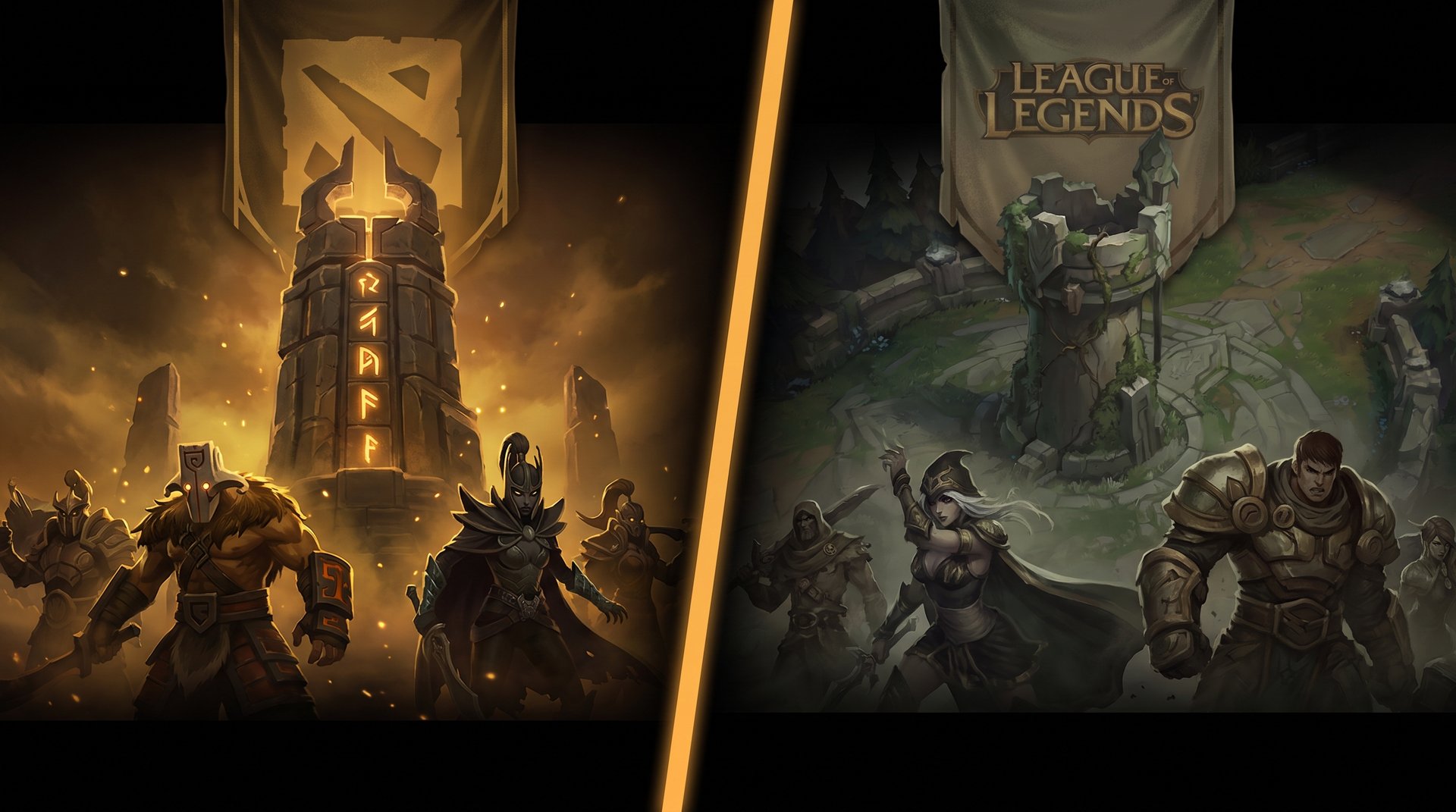
League of Legends is the most common comparison point for Dota 2, and it is a fair one. Both games descend from the same Warcraft III map, both are five-versus-five, and both revolve around destroying the enemy base. But the design philosophies diverged sharply after the split.
Where LoL Has the Edge
LoL’s champion pool is larger than Dota 2’s hero pool. Riot Games has released champions at a high rate over the game’s history, and the breadth of options at high level is enormous. The competitive meta in League at the highest level is also genuinely complex, with professional teams running sophisticated draft strategies and macro rotations that beginners would not recognize.
LoL’s ranked scene is also larger in raw player numbers, which means the pool of opponents at every rank is deeper and more refined. Competition at the equivalent of Challenger in LoL is extremely demanding.
Where Dota 2 Is Generally Considered Harder
The community consensus — and it is a strong consensus, visible across gaming forums, Reddit threads, and player interviews — holds that Dota 2 is harder to learn and harder to reach a competent level in. The specific reasons cited most often:
- Denying has no LoL equivalent. The extra mechanical layer in the laning phase means new Dota 2 players are disadvantaged even in basics that LoL players do not have to think about.
- No fountain safety. In LoL, your base fountain heals you and is generally safe. In Dota 2, the fountain can be reached and fountain-farmed by some heroes. The safe zones are smaller.
- Steeper comeback mechanic dependency. LoL has comeback mechanics but Dota 2’s are more extreme — Aegis, Roshan power swings, and buybacks can reverse near-certain defeats. This means even a winning team must maintain focus and perfect execution, creating sustained pressure that does not exist to the same degree in LoL.
- Items are more complex. LoL items largely provide straightforward stat bonuses with some actives. Dota 2 items often have active abilities that interact with heroes in non-obvious ways. Getting the right item in the right scenario requires game knowledge that takes much longer to develop.
It is worth noting that “harder” does not mean “better.” LoL’s accessibility is a feature, not a bug. Riot deliberately designed the game to onboard new players faster, and it works. If you want to reach a point where the game feels competitively engaging sooner, LoL may serve that goal better. Dota 2 rewards you differently — but it asks you to wait longer.
For players who do commit to Dota 2 and want to shortcut the frustrating early grind, professional MMR boosting can help place you in a rank where the actual strategic complexity of the game becomes visible faster. Herald and Guardian brackets often mask the real depth of Dota 2 because everyone in those brackets is making so many fundamental errors that strategy is nearly irrelevant.
Dota 2 vs Counter-Strike 2: Different Kinds of Hard
Comparing Dota 2 and CS2 is comparing two different types of difficulty. They are both competitive, both deep, and both brutal to newcomers — but the axis of difficulty is almost entirely different.
CS2’s Mechanical Demands
Counter-Strike 2 — and its predecessor CS:GO — is commonly cited as having one of the highest mechanical skill ceilings in competitive gaming when it comes to raw aim and movement. Spray control, crosshair placement, counter-strafing, and grenade lineup accuracy require physical precision and repetition that can take thousands of hours to master. At the professional level, the difference between a player who can hold an angle reliably and one who cannot is massive.
CS2 also has a deep economy and utility system. Knowing when to force-buy, when to eco, how to use flash timings, smoke lineups, molotov placements — the strategic layer is real and substantial.
Where Dota 2 Arguably Has More Complexity
The strategic decision space in Dota 2 is arguably wider than CS2’s. In CS2, the map pool is limited (typically seven to nine maps in active duty), the win conditions are fixed (plant or defuse), and the information economy — while important — is constrained to a finite set of positions. Dota 2 has a single map but an effectively infinite combination of draft, item, and timing choices that change every patch.
CS2’s hero-equivalent — the agents — provide no mechanical differentiation. Every player uses the same movement speed, the same hitbox roughly, the same gun pool. Dota 2’s hero pool means every match is essentially played with different rules depending on what was drafted.
The community verdict on CS2 vs Dota 2 is split, which is itself revealing. Players who prioritize pure mechanical skill often argue CS2 is harder. Players who prioritize strategic complexity often argue Dota 2 is harder. Both are probably right within their own framework.
Dota 2 vs StarCraft II: The APM Argument
StarCraft II occupies a unique position in this discussion. It is widely cited — including by professional gamers and game designers — as requiring the highest raw mechanical execution of any major competitive game. The argument rests on Actions Per Minute (APM).
Why StarCraft II’s Mechanical Ceiling Is Unique
Professional StarCraft II players routinely perform 200 to 300 actions per minute during peak moments of a game. Some elite players have recorded sustained APM exceeding 400 during intense early-game periods. The game requires simultaneous macro management (building structures, managing economy, researching upgrades, producing units) and micro management (controlling individual units in combat, executing multi-pronged attacks, retreating and re-engaging). The player must do all of this alone.
This is a physically demanding requirement. Many retired professional players have cited repetitive stress injuries from the physical burden of the game. The barrier to entry at professional level is partly biological — some players physically cannot reach the APM thresholds that top competitors sustain.
Where the Comparison Gets Complicated
StarCraft II is a 1v1 game. The coordination and communication requirements that exist in Dota 2 — five players working as a unit, coordinating drafts, rotations, teamfight timing, and resource allocation — simply do not exist in the same form. The complexity loads are different, not ranked.
A strong argument can be made that StarCraft II requires more individual mechanical execution than Dota 2, while Dota 2 requires more individual strategic decision-making within a team framework. Neither argument is wrong — they are measuring different things.
It is also worth noting that StarCraft II’s competitive scene has contracted significantly compared to its peak during the 2010-2014 era. Fewer players means a shallower comparison pool at any given rank, which is a practical consideration if you are comparing competitive ladders.
Other Contenders: Valorant, Fighting Games, and Chess-Like Depth
Valorant
Valorant attempts to combine CS:GO’s precise gunplay with Overwatch-style agent abilities. It has grown into one of the largest competitive shooter communities and its ranked system is taken seriously. Mechanically, its gunplay is demanding — Riot borrowed and refined CS:GO’s fundamentals deliberately.
The common community view is that Valorant sits between CS2 and Overwatch in mechanical difficulty, with agent ability complexity adding a strategic layer that pure-aim shooters lack. Compared to Dota 2, the general consensus is that Dota 2 has a significantly higher knowledge load and steeper initial learning curve, while Valorant’s aim ceiling is comparable to CS2’s.
Traditional Fighting Games
Games like Street Fighter 6, Tekken 8, and Guilty Gear Strive carry their own claims to being the hardest competitive genre. Frame data knowledge, execution windows measured in fractions of a second, matchup-specific knowledge for dozens of characters — top-level fighting game play is extraordinarily demanding.
Where fighting games differ from Dota 2 is in scope. A fighting game match lasts minutes; the decision density is extremely high but the number of variables at any given moment is lower than in a 50-minute Dota 2 match. Fighting games are often cited as having the highest per-second decision difficulty, while Dota 2 has the highest total decision volume across a full match.
Chess and Turn-Based Complexity
Chess is frequently cited in these conversations as a baseline for “infinite strategic depth.” It is worth noting that chess has been solved to significant depth by computers, and top human play is essentially memorization of opening theory to a greater degree than Dota 2 patched meta ever could be. Dota 2’s constant patching means memorized solutions decay quickly, which adds a perpetual knowledge load that static games like chess do not share.
Side-by-Side Difficulty Comparison
| Dimension | Dota 2 | LoL | CS2 | StarCraft II | Valorant |
|---|---|---|---|---|---|
| Mechanical Ceiling | High | Medium-High | Very High | Extremely High | High |
| Knowledge Load | Extremely High | High | Medium-High | High | Medium |
| Learning Curve | Very Steep | Steep | Steep | Very Steep | Moderate |
| Strategic Depth | Extremely High | High | High | High | Medium-High |
| Teamwork Requirement | Very High | High | High | N/A (1v1) | High |
| Punish Rate | Extremely High | Medium-High | High | Very High | High |
| Player Count (2026) | Medium | Very Large | Very Large | Small | Large |
Ratings reflect community consensus from player discussions, competitive analysis, and widely referenced forum discourse. They are not derived from controlled research.
Why MMR Is the Truest Test of Difficulty
One underappreciated way to measure game difficulty is to look at how distributed the player population is across skill ranks. In games where even average-effort players can reach high ranks, the ranking system becomes less informative. In games where the majority of the player base concentrates in the lower half of the rank spectrum despite many hundreds of hours played, the game is demonstrably harder to improve at.
Dota 2’s MMR distribution is often cited in this context. The median Dota 2 player — the player at exactly the 50th percentile — sits at a rank that most active players would describe as “bad at the game.” This is not a judgment; it reflects how steep the curve is. The distance between a player who has put in 500 hours and a player who has put in 2,000 hours remains enormous, which is unusual compared to many other competitive titles where 500 hours approaches a ceiling of diminishing returns.
This is also why MMR boosting exists as a service in Dota 2 specifically. The grind required to climb is so long, and the feedback loop so punishing, that a meaningful portion of players opt to hire professionals to demonstrate what higher-level play looks like in their account. Players who use Dota 2 boosting services often report that playing in their newly boosted bracket is itself educational — seeing how professionals draft, rotate, and itemize at that level is harder to learn through guides than through direct observation.
If you have been grinding and not seeing the results you expect, it may not be that you are bad at Dota 2. It may be that Dota 2 is genuinely that hard, and the feedback loop in low brackets is too noisy to teach the right lessons. A professional Dota 2 coaching session can identify specific, addressable gaps in your game that hours of solo play might never surface.
The Verdict: Is Dota 2 the Hardest Competitive Game?
The honest answer is: it depends on the dimension you are measuring.
If you define “hardest” as total knowledge load and initial barrier to entry, Dota 2 has the strongest claim to the title. The combination of a large hero pool, unique mechanics found nowhere else, a highly punishing mistake loop, and a team coordination requirement make it unusually demanding to learn from scratch.
If you define “hardest” as peak mechanical execution, StarCraft II and CS2 make strong competing claims. StarCraft’s APM requirements at professional level are physically demanding in a way that Dota 2 is not. CS2’s aiming mechanics have a ceiling that requires years of deliberate practice to approach.
If you define “hardest” as total strategic decision complexity over the course of a career, Dota 2 may again lead — the constant patching, the draft variability, and the team synergy requirements combine to make the strategic layer effectively infinite.
What is clear is that Dota 2 does not need to “win” this debate to justify its reputation. The game is extraordinarily demanding, the learning curve is genuinely brutal, and the rewards for mastering it are real. Players who reach high MMR in Dota 2 have demonstrated a kind of multidimensional competence that transfers broadly — game sense, resource management, communication under pressure, and adaptability.
That is why reaching higher MMR in Dota 2 is a meaningful achievement, not just a number. And it is why services like TeamSmurf’s MMR boost exist — not to cheat the system, but to move past brackets where bad matchmaking and noisy feedback prevent real learning from happening.
Climb Past the Noise — Reach the Rank Where Dota 2 Actually Makes Sense
The hardest part of Dota 2 is that low-bracket games teach you the wrong lessons. Let a professional booster place you where strategy matters, then experience Dota 2 the way it was designed to be played.
Get My MMR Boost Book a Coaching Session



