How to Convert a Lead into Roshan (Shotcalling Template)

Winning a teamfight in Dota 2 is not the same as winning the game. The most common reason skilled teams lose games they should have won is the failure to convert early and mid-game advantages into Roshan control and subsequent high ground access. The decision window after a won teamfight is typically 30-90 seconds — the time between the first enemy death and the first buyback. Most teams at Archon through Divine waste this window by default farming rather than executing a coordinated Roshan attempt.
This guide provides a concrete shotcalling template for converting a lead into Roshan and then converting Roshan into a high ground siege. The template is built around the decision criteria that Immortal teams use to evaluate whether a Roshan attempt is viable, how to communicate the decision under game-state pressure, and how to chain the Roshan kill into a high ground push before the enemy can recover.
The template is structured as a series of decision gates — binary yes/no evaluations that any player can make under pressure without requiring deep game knowledge. Each gate is explained with the reasoning behind it so you can adapt it to non-standard game states where the template does not apply directly.
Table of Contents
Why Lead-to-Roshan Conversions Fail
The failure mode is almost always the same: the team that wins a fight disperses to farm the creep wave or return to base, burning 60-90 seconds of post-fight advantage on individual resource collection. By the time the winning team groups again, the first enemy buyback has resolved, cooldowns have partially refreshed, and the numerical advantage that made Roshan safe has evaporated.
The Information Gap Problem
The second most common failure mode is attempting Roshan without knowing the enemy team’s buyback status. Walking into the Roshan pit with three enemies who have buyback gold and two potential buybacks available turns a safe Roshan into a potential teamwipe in the pit. The decision gate framework below addresses this directly — Roshan is only called when specific information about buyback availability is either confirmed or acceptably estimated.
The Communication Problem
Even when the correct decision is Roshan, many teams fail to execute because no one calls it explicitly and clearly. “Let’s Rosh?” followed by silence while everyone farms is not a shotcall — it is a suggestion. Shotcalling is a declarative statement that creates a shared action plan and assigns accountability. The scripts in this guide are written to be declarative rather than interrogative for exactly this reason.
The Decision Gate Framework
The decision to attempt Roshan after a won fight runs through five sequential gates. Pass all five and the call is correct. Fail any one and the call either delays to a better window or targets a different objective.
Gate 1: Enemy Casualty Count
Question: How many enemies are dead right now?
Pass threshold: Three or more enemies dead simultaneously, OR two dead including the primary enemy carry.
Fail state: Only one or two enemies dead (excluding the carry). Two dead supports with the carry alive is not a Roshan window — it is a farm window. The carry can still contest or buyback within your Roshan attempt window and create a dangerous pit fight.
Why: Roshan in 7.41c takes roughly 40-60 seconds for a typical early-to-mid game team. An enemy carry who buys back at the 30-second mark has enough time to reach the pit before you finish. You need three enemies dead to have a comfortable cushion.
Gate 2: Buyback Availability Check
Question: Do the dead enemies have buyback gold available?
Pass threshold: Primary carry has no buyback (recently used it, or does not have enough gold), OR two or more enemies have used buyback in the last 60 seconds.
Fail state: Enemy carry has buyback available and was killed by spells (not Aegis). Enemy position 1 buying back into a pit fight while you are 40 seconds into the Roshan attempt is high-risk.
How to check: The scoreboard shows buyback availability for each hero. Check it immediately after the teamfight resolves — the 5-10 seconds you spend on the scoreboard during the walk to the pit is the correct use of that time. If you cannot check (high-chaos fight), estimate based on gold — carries with less than 2,000 net worth above their item build typically cannot afford buyback.
Gate 3: Your Team’s Health State
Question: Can your team start and finish Roshan before needing to retreat for healing?
Pass threshold: At least three heroes above 40% HP, with the primary damage dealer above 50% HP.
Fail state: Multiple heroes are below 30% HP. Starting Roshan with three heroes below 30% HP means you will either finish slowly (allowing buybacks) or get disrupted mid-attempt by a single enemy hero who bursts your low-HP team.
Gate 4: Roshan HP Check
Question: Is Roshan currently alive?
Pass threshold: Yes (obviously). But critically — if Roshan was killed in the last 8 minutes, the respawn timer has not reset. Know when Roshan died if you were tracking it.
Why this matters: Missing the Roshan respawn window and walking to an empty pit wastes 60-90 seconds of post-fight advantage that you then spend farming anyway — the worst of both options.
Gate 5: High Ground Readiness After Rosh
Question: After getting Aegis, can your team immediately push high ground before the next enemy buyback expires?
Pass threshold: Your carry has enough items to threaten a barracks within 90 seconds of Aegis pickup, and your supports have enough utility to enable the push (Force Staff, Glimmer, Smoke).
Fail state: Your carry needs 2-3 more items before high ground is viable. In this case, Roshan is still worth doing for the Aegis and bounty, but the plan changes: you take the rax if the opportunity presents itself, but the primary goal is using the post-Rosh window to farm the carry to their next power spike in a safe environment.
| Gate | Pass Condition | Fail Action |
|---|---|---|
| 1. Enemy Casualties | 3+ dead, or carry dead | Farm waves, take objectives |
| 2. Buyback Check | Carry has no buyback | Delay Rosh 2-3 min, farm first |
| 3. Team HP | 3+ heroes above 40% HP | Heal at base, then Rosh |
| 4. Rosh Alive | Yes (confirm respawn timer) | Take towers instead |
| 5. Post-Rosh Readiness | Carry can threaten rax in 90 sec | Rosh for Aegis, farm to next spike |
How to Call Roshan After a Fight
The call itself is a skill. Most sub-Immortal players either do not call it at all (leaving it to someone else) or call it with insufficient conviction and specificity to create coordinated action. Here is the structure of an effective Roshan call.
The Immediate Post-Fight Call (First 10 seconds)
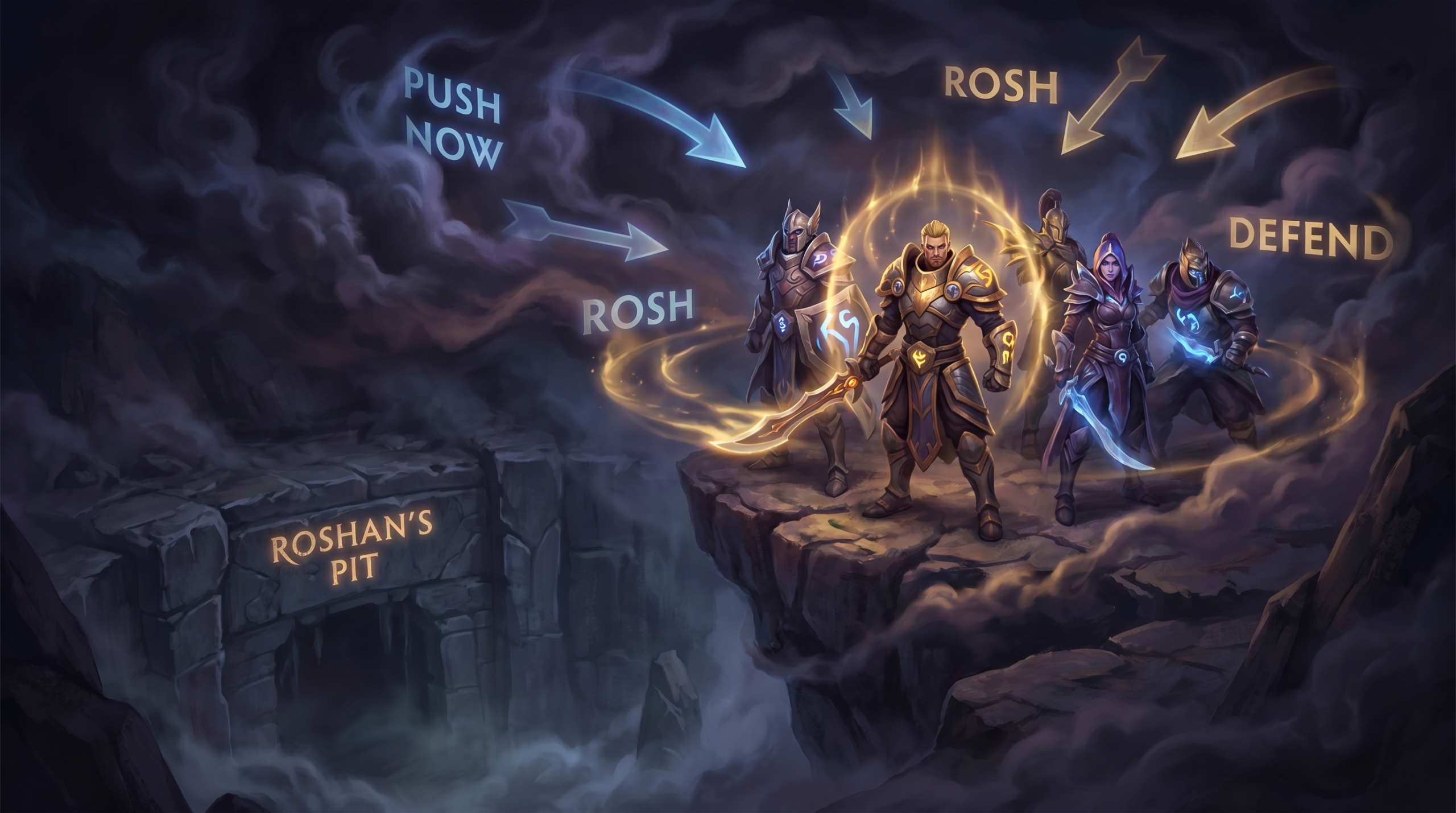
The call should happen before anyone has started farming. The window where teammates are most likely to follow a direction is immediately after a fight resolves, before the habit of returning to farm takes over. Your first communication should be a direction, not a question: “Roshan — go now.” Not “should we Rosh?” Not “maybe Rosh?” A declarative direction.
Information Attached to the Call
After the direction, attach the key information that justifies the call: “Rosh — carry dead, no buyback, three of us above half HP.” This takes 5 seconds to communicate and pre-empts the “but what about…” hesitation that kills execution. Players who hear the justification follow more confidently than players who only hear the direction.
Designating Roles During the Pit Attempt
Assign a watcher and a damage dealer before entering the pit. The watcher’s job is to monitor the enemy respawn timers and any incoming hero signals on the minimap and call abort if a threat approaches. The damage dealer’s job is maximum sustained damage output on Roshan. Everyone else is both attacking Roshan and watching flanks. This role assignment, communicated in 10 seconds while walking to the pit, prevents the chaos of everyone watching minimap and no one attacking Roshan.
Converting Roshan into High Ground Access
Aegis possession changes the risk calculus for high ground significantly. The carry with Aegis can absorb one death — which means they can engage in a scenario that would normally be too risky without a defensive positioning advantage. The post-Rosh window is where most sub-Immortal teams convert their advantage into a game-ending push or waste it by returning to base and losing momentum.
Immediate Smoke After Aegis
The highest-tempo sequence after a Roshan kill is immediate Smoke of Deceit followed by a five-man push into high ground before the first buyback resolves. Smoke timing: buy it before the Roshan fight if possible (it should already be in your support’s inventory), activate immediately after Aegis is picked up, walk through the jungle toward the target lane ramp, and break Smoke at the ramp entrance. This sequence, when executed smoothly, reaches the enemy tier 3 before the second enemy buyback is available.
Lane Selection After Roshan
The correct lane to push after Roshan depends on where the teamfight occurred and where the enemy heroes died. Push the lane closest to the teamfight location, not necessarily the lane where your carry is strongest. Speed of arrival at the ramp is more important than lane-specific carry advantage because the window is time-sensitive. If the fight was mid-river, push mid. If the fight was at the bottom rune, push bottom. Minimize the walking time from fight location to ramp.
When to Abort the High Ground Push
The abort trigger is specific: if three or more enemies have resolved buybacks before you reach the tier 3, abort the push and take the nearest undefended tower instead. Do not abandon all post-Rosh value — take a tower or a tier 2 shrine, then regroup for the next opportunity. A failed high ground push that costs two or three heroes their Aegis charges is a disaster that can hand the enemy a game-winning swing.
Timing Windows by Minute
The specific timing of Roshan attempts changes as the game progresses because buyback costs, hero power levels, and team fight dynamics all evolve. Here are the standard timing windows by phase.
Early Game (Minutes 10-20)
Early Rosh is viable primarily when: your team has an early game teamfight draft (Tide, Magnus, Warlock), you have won a fight decisively at the 10-12 minute mark, and the enemy carry is still building their first major item. Early Rosh is about the Aegis for your early game hero (often the offlane or support initiator) plus the bounty gold. The subsequent push should target tier 2 towers rather than high ground — it is too early for most carries to close games on high ground.
Mid Game (Minutes 20-35)
This is the highest-leverage Roshan window. Carries are at their first-to-second major item power spike, the gold advantage from two or three towers is compounding, and the enemy team is transitioning between mid-game and late-game compositions. Rosh at this phase with Aegis on the primary carry plus a subsequent smokescreen push is the sequence that ends 40-60% of Immortal-level games. The five-gate decision framework above is optimized for this phase.
Late Game (Minutes 35+)
Late Rosh attempts are higher-risk because buyback gold is available for every hero and the penalty for a failed pit fight is severe. The same decision gates apply, but the buyback check (Gate 2) becomes more important than at any other phase. A late game Roshan attempt with the enemy carry alive and rich on gold should only proceed if you have vision confirming their buyback was recently used (watch for the death timer in the bottom bar that indicates a buyback occurred).
When Not to Roshan After a Win
The template above assumes Roshan is the correct objective. Sometimes it is not, even after a decisive teamfight win. Recognize these four scenarios where an alternative objective is better.
The enemy base is open and defenseless: If a fight happens near the enemy base and you have killed the enemy team mid-push, the highest-value action is pushing into the base directly rather than walking back to Roshan. Roshan provides Aegis — an open base provides rax and game-ending victory.
Your carry is close to a game-deciding item: If your carry is 800 gold from a Black King Bar or Heart of Tarrasque and the fight was near a creep wave, four minutes of uncontested farming may deliver more total team power than an Aegis. Evaluate the gold value of the Roshan kill (Aegis duration + bounty) against the gold available from a free farming window.
The enemy has heroes that neutralize Aegis: Doom’s ultimate eliminates spell immunity. Necrophos’s Reaper’s Scythe prevents reincarnation. If the enemy team has Doom and their carry is alive, an Aegis provides less protection than standard. Factor this into the decision.
Your map control is the limiting factor: If you have few towers and the enemy has a strong split push hero (Nature’s Prophet, Lycan), taking towers after the fight may provide more long-term value than Roshan. Each tier 2 tower gives your team more map safety to execute subsequent objectives without being interrupted by rat-pushing threats.
Shotcalling Scripts for In-Game Use
These scripts are written for direct use in voice communication or team chat. Brevity matters — the call should be complete in 10 words or less. Practice saying them until they are automatic.
Standard Rosh call: “Rosh now — carry dead, no buyback.”
Roshan with uncertainty on buyback: “Rosh if we move fast — buyback risk, hit hard.”
Post-Aegis push call: “Smoke mid — push for rax, Aegis on [carry name].”
Abort signal during pit: “Abort Rosh — [hero name] incoming. Take tower instead.”
Alternative objective call: “Skip Rosh — take tier 2 bot while they are dead.”
For players who want to develop better shot calling habits and objective control, our Immortal coaching sessions include live shotcalling drills on your real match replays. Our MMR boost replays also demonstrate Immortal-level objective decision-making from inside your own match history.
Common Roshan Attempt Mistakes and How to Avoid Them
Even when teams pass the decision gates and commit to a Roshan attempt, execution errors frequently derail the outcome. These are the most common tactical errors during Roshan fights and the specific corrections that prevent them.
Starting Roshan Without a Dedicated Watcher
Every hero in the Roshan pit attacking Roshan is a hero who is not watching the minimap for incoming threats. Teams that place all five heroes inside the pit and focus exclusively on killing Roshan are setting up for an ambush by the first enemy hero to respawn and smoke-walk toward the pit. Designate the position 4 support as the pit watcher before entering — their job is to stand at the pit entrance facing the most likely enemy approach direction and call any threat the moment it appears on the minimap. One hero watching is worth more than the marginal DPS contribution of a fifth hero attacking Roshan.
Killing Roshan Without a Smoke Plan for After
The post-Rosh window is time-critical. Teams that kill Roshan and then spend 30 seconds distributing the Aegis, buying items, and debating which lane to push are wasting their advantage window. The smoke, the lane selection, and the push plan should all be decided before the Roshan kill, not after it. If your support does not have Smoke in their inventory when the Roshan fight starts, buy it during the walk to the pit — not after the kill. Pre-planning the post-Rosh sequence is the difference between a fast five-man push and a slow grouping process that allows the enemy to set up a defense.
Giving Aegis to the Wrong Hero
The Aegis defaults to the hero who lands the killing blow on Roshan, which is sometimes the wrong hero for the post-Rosh push. If your support accidentally kills Roshan, the Aegis goes to the support — a hero who should not be the primary risk-taker in a high ground push. Before the fight, explicitly clarify who should receive the Aegis: typically the primary carry or the primary initiation hero (depending on whether the push is a DPS-focused or fight-initiation approach). Some teams assign the Roshan kill credit to the carry by having other heroes reduce Roshan to low HP and then letting the carry land the final hit.
Not Accounting for Enemy Smokes
The enemy team knows that a won teamfight often leads to a Roshan attempt. Experienced enemy teams use Smoke of Deceit immediately after a lost teamfight to walk a surviving hero (or a newly-respawned hero) toward the Roshan pit to disrupt the attempt. If your watcher is not actively watching for incoming smoked heroes and your team has no ward coverage of the approaches to the pit, a single smoked disabler can arrive during the Roshan fight and create enough chaos to turn a clean Rosh kill into a pit fight that kills two of your heroes.
The counter is pre-placed sentries at the main smoke approach corridors adjacent to the pit before starting the attempt. A single sentry at the most common smoke approach for the enemy team’s composition (check their hero list — which hero would most likely be sent to disrupt?) is sufficient to reveal an incoming smoke disruption with 10-15 seconds of warning time.
Ready to Skip the Grind?
Team Smurf’s Immortal boosters demonstrate correct objective timing and shotcalling in your own match history.
Get Your Boost Now Talk to Our Team